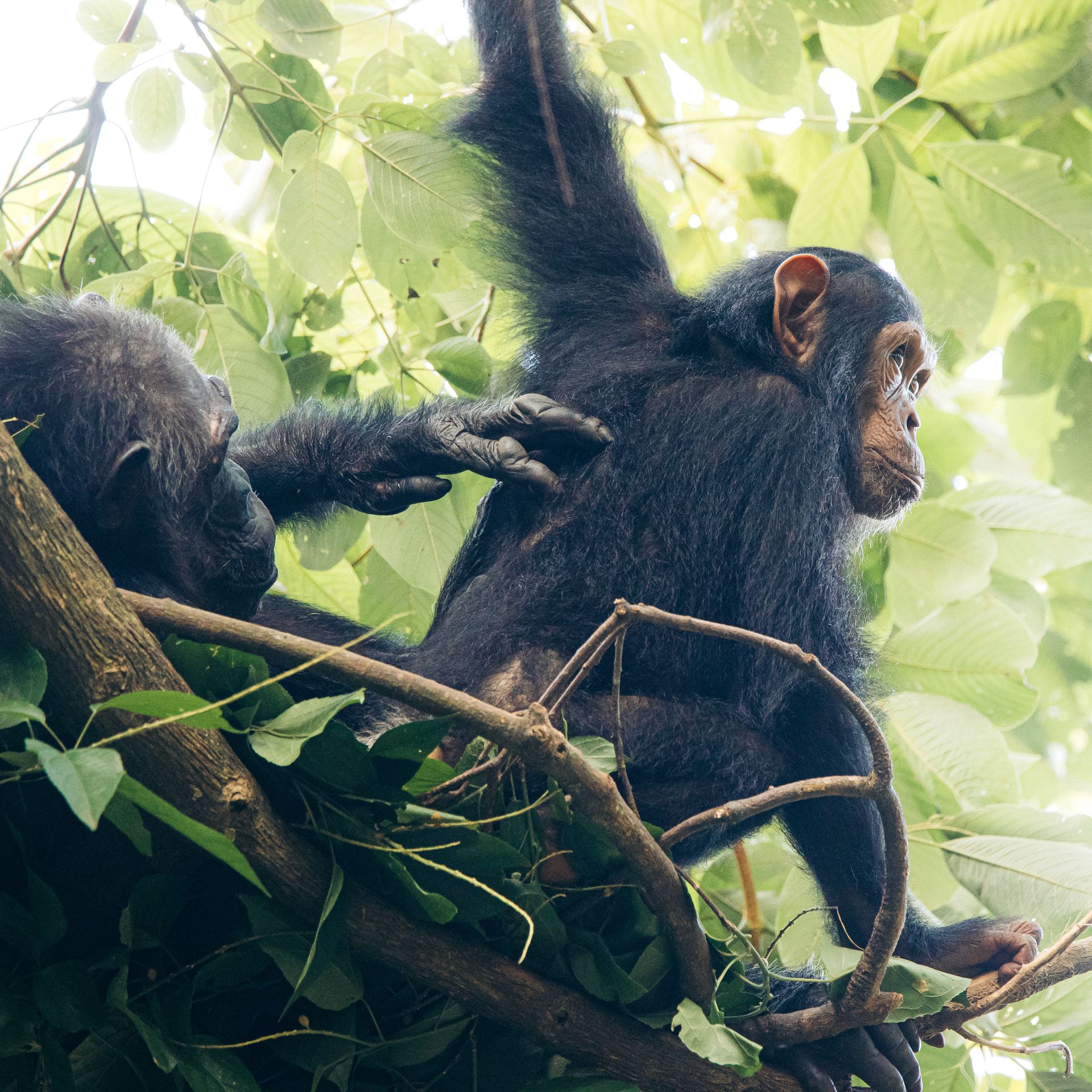
Gombe National Park is Tanzania’s smallest national park and one of Africa’s most storied chimpanzee landscapes. Set on the steep forested edge of Lake Tanganyika, it is less a conventional safari than an intimate primate pilgrimage, shaped by walking trails, research history and extraordinary lake views.
Kasekela chimpanzee range
The Kasekela community is the heart of Gombe’s chimp trekking experience and the area most closely associated with the park’s long research history. Forest trails, steep slopes and careful tracking define the day, with sightings depending on chimp movement and conditions.
Lake Tanganyika shoreline
Gombe’s shoreline gives the park an unusual softness after time in the forest. Boats, beaches and clear lake water create a striking contrast to the intensity of chimp trekking, making the setting feel more like a remote natural amphitheatre than a typical safari park.
Forest ridges and waterfalls
Beyond the main chimp areas, Gombe’s ridges, valleys and waterfalls hold red-tailed monkeys, red colobus, birds and layered forest life. These routes help travellers understand the park as a complete ecosystem, not only a single-species destination.
Gombe is foremost a chimpanzee destination, with the chance to track habituated communities on foot in steep forest above Lake Tanganyika. Travellers may also see red colobus, red-tailed monkeys, olive baboons, bushbuck, forest birds and lake wildlife. It is intimate, physical and primate-focused rather than a broad big-game safari.
Tanzania works year-round, but the answer depends on which region you visit and what you want to see.
June to October is peak dry season. Vegetation thins, animals cluster around water, and the northern Serengeti delivers its most dramatic wildlife as herds cross into Kenya's Mara. Prices are highest and the best camps book 6–12 months ahead.
January to March is the most underrated window. The southern Serengeti calving season brings intense predator action, the light is extraordinary for photography and visitor numbers are much lower than the peak.
Late March to May brings green landscapes and lower rates, but some camps close entirely as this is the rainy season. November and early December offer a sweet spot: short rains, calving herds returning south, and competitive pricing.
For UK families: July–August aligns with peak northern Serengeti migration. October half-term catches the tail end. Easter falls in the variable rain period and Tarangire and Ngorongoro are more reliable than the Serengeti in April.

Lodge choice in Gombe is extremely limited, with simple, small-scale accommodation close to the lake and forest trails. Travellers should expect comfort with a remote, practical edge rather than a luxury lodge circuit. The best stays are chosen for chimp access, guiding and the rare setting.
Gombe’s global acclaim is inseparable from Jane Goodall’s pioneering chimpanzee research, which began here in 1960 and transformed how the world understood primate behaviour. That scientific legacy gives the park a depth of meaning far beyond its small size.
This is not a destination where lodge awards define the experience. Gombe’s prestige comes from its research history, its lake-and-forest beauty and the privilege of entering a landscape that changed conservation thinking worldwide.
Gombe is for primate enthusiasts, conservation-minded travellers, researchers at heart and anyone moved by the story of Jane Goodall and chimpanzee behaviour. It is a small park with an unusually large emotional and scientific presence.
It suits couples, solo travellers and older families who are comfortable walking, climbing and accepting that wildlife encounters are shaped by forest conditions rather than vehicle convenience.
It is less suited to travellers seeking luxury variety, Big Five game drives or a relaxed first safari. Gombe works best when the chimpanzee experience is the clear reason for going.
From the UK, travellers usually fly into Dar es Salaam or Kilimanjaro, then connect onward to Kigoma by domestic flight or specialist routing.
From Kigoma, access to Gombe is normally by boat across Lake Tanganyika. Transfer times depend on boat type, weather and lodge arrangements, so this is a destination that needs careful logistical planning.
Gombe is often combined with western Tanzania or used as a specialist primate extension. It is not a simple add-on to the northern safari circuit unless flights and timing are built around it.
Two or three nights is usually sensible. Two nights can allow one main chimp trek, while three gives more flexibility for weather, chimp movement, lake time and a less rushed understanding of the forest.
Gombe can be visited for chimp trekking across much of the year, but drier periods often make forest walking easier and chimp tracking more comfortable. Exact timing should be matched to flight access and wider Tanzania routing.
No. Gombe is not a classic vehicle-based safari park. It is a specialist chimpanzee and forest destination, best chosen for primates, conservation history and Lake Tanganyika scenery rather than big-game drives.
Most travellers route through Kigoma, then continue by boat across Lake Tanganyika to the park. The journey is part of what keeps Gombe feeling remote, but it requires more planning than Tanzania’s mainstream safari areas.
Yes, Gombe can combine with Katavi or Mahale in a specialist western Tanzania itinerary, though logistics are flight- and boat-led. It works best for travellers who actively want remote primate and wilderness experiences.
The main trade-off is narrow focus. Gombe can be unforgettable for chimpanzees and conservation history, but it offers limited lodge choice, physical trekking and none of the broad big-game safari rhythm many travellers expect.


As an independent partner of 360 Private Travel, eligible flight-inclusive holidays booked through us are financially protected by 360 Private Travel Ltd under the UK ATOL scheme, ATOL number 7514. 360 Private Travel Ltd is also IATA accredited under IATA number 91200056.
Qualifying flight-inclusive holidays are financially protected under the UK ATOL scheme, where applicable. You will receive an ATOL Certificate confirming the protection covering your individual booking.



.png)

