
Get the accommodation right and a multi-generational safari becomes one of the most memorable trips you can experience together. East and Southern Africa offer properties built precisely for this — from exclusive-use houses and lodges where your guide knows every family member by the end of the first drive. Activities can be split by age and energy simultaneously and the pace belongs entirely to your group. Kenya, Tanzania, South Africa, and Botswana are the four strongest destinations, each suiting a different version of the trip.
The right destination depends on the specific composition of your group — particularly the age and mobility of older travellers and the ages of any children. Here is how the four strongest destinations compare.
Kenya: Easiest logistics for large groups - Nairobi is a well-connected hub, game drives in the Mara suit all fitness levels and the Laikipia conservancies offer exceptional exclusive-use houses with direct UK flights. A beach extension offers a nice relaxing end.
South Africa: No malaria in several key reserves - the right choice if young children or older travellers are part of the group. The widest range of exclusive-use lodges and safari houses in Africa. A Cape Town extension works well for families who want more than the bush alone.
Tanzania: Best when the group's priority is wildlife volume — the Serengeti and Ngorongoro are genuinely jaw-dropping at any age. Internal flights are well-organised. Fewer exclusive-use options than Kenya or South Africa but the best ones are outstanding. Zanzibar offers a nice beach extension to a safari.
Botswana: The most private option. Very few other vehicles in the concessions and the Okavango Delta offers an ecosystem unlike anywhere else in Africa. Best suited to groups where the adults want deep immersion and children are 6 or older.
This is the most common configuration and the one that requires the most considered planning. The key decision is accommodation. When you have an exclusive-use property, your guide knows every family member's preferences within half a day. Activities can split simultaneously: children on a junior ranger programme while grandparents take a longer afternoon drive. Dinner happens when your family is ready. Angama Mara in Kenya's Mara Triangle is one of the strongest options for this configuration- a clifftop position above the Great Rift Valley that genuinely impresses across all ages. In South Africa, Phinda Homestead offers exclusive-use in a malaria-free setting, with children's programmes that keep younger guests engaged while adults are out on longer drives.
When the trip is anchored by grandparents in their 60s or 70s, the planning priorities shift. Accessibility and pace matter more than remoteness. Accommodation comfort -bathroom quality, bed height, path gradients between areas of the lodge - becomes a practical consideration rather than an indulgent one. The good news is that lodges at the £10,000-per-person tier have all of this resolved as a matter of course. Singita Pamushana in Zimbabwe offers exceptional suite comfort, a short transfer from the airstrip and a setting on Lake Mutirikwi that is quietly unlike anywhere else in Southern Africa. In East Africa, Cottar's 1920s Camp in the Maasai Mara offers exclusive-use tenting with a level of service that removes any physical barriers to the experience.
A multi-generational trip does not always involve young children. Groups of adult siblings or cousins in their 30s and 40s travelling with parents in their 60s and 70s have become one of the fastest-growing multi-gen configurations, often framed around a significant birthday or anniversary. These groups want a social atmosphere, flexible daily schedules, and enough space that family members are not sharing walls. Exclusive-use camps work particularly well here: different adults can pursue different activities simultaneously without any coordination overhead. Asilia Africa's Namiri Plains in Tanzania — eight tents taken exclusively, extraordinary predator density in the eastern Serengeti — is an excellent option for this type.
For most multi-generational groups, an exclusive-use arrangement is not a luxury — it is what makes the trip function properly. When you have the camp to yourselves, guides calibrate every activity to your group's specific mix of ages, interests, and mobility. There are no strangers to negotiate with over departure times or activity preferences. The full spectrum of African lodges offers exclusive-use options at varying price points: from purpose-built safari houses sleeping 10 to 12 guests — where the per-person cost becomes much more manageable when the house is full — to intimate six-tent camps taken over entirely for a group. Wilderness Qorokwe in Botswana's Okavango Delta and andBeyond Phinda Homestead in South Africa are two of the most consistently excellent options in this category.
For smaller multi-gen groups where full exclusive use feels like more space than needed, a lodge with well-designed family suites is the practical alternative. The best configurations offer interconnecting rooms or adjacent cottage clusters that give grandparents privacy, parents a shared sitting space, and children their own sleeping area - rather than simply connecting rooms through a thin wall. Lemala Ndutu in Tanzania and Elewana Sand River Masai Mara in Kenya both offer configurations that work for three-generation groups without requiring a full camp buyout.
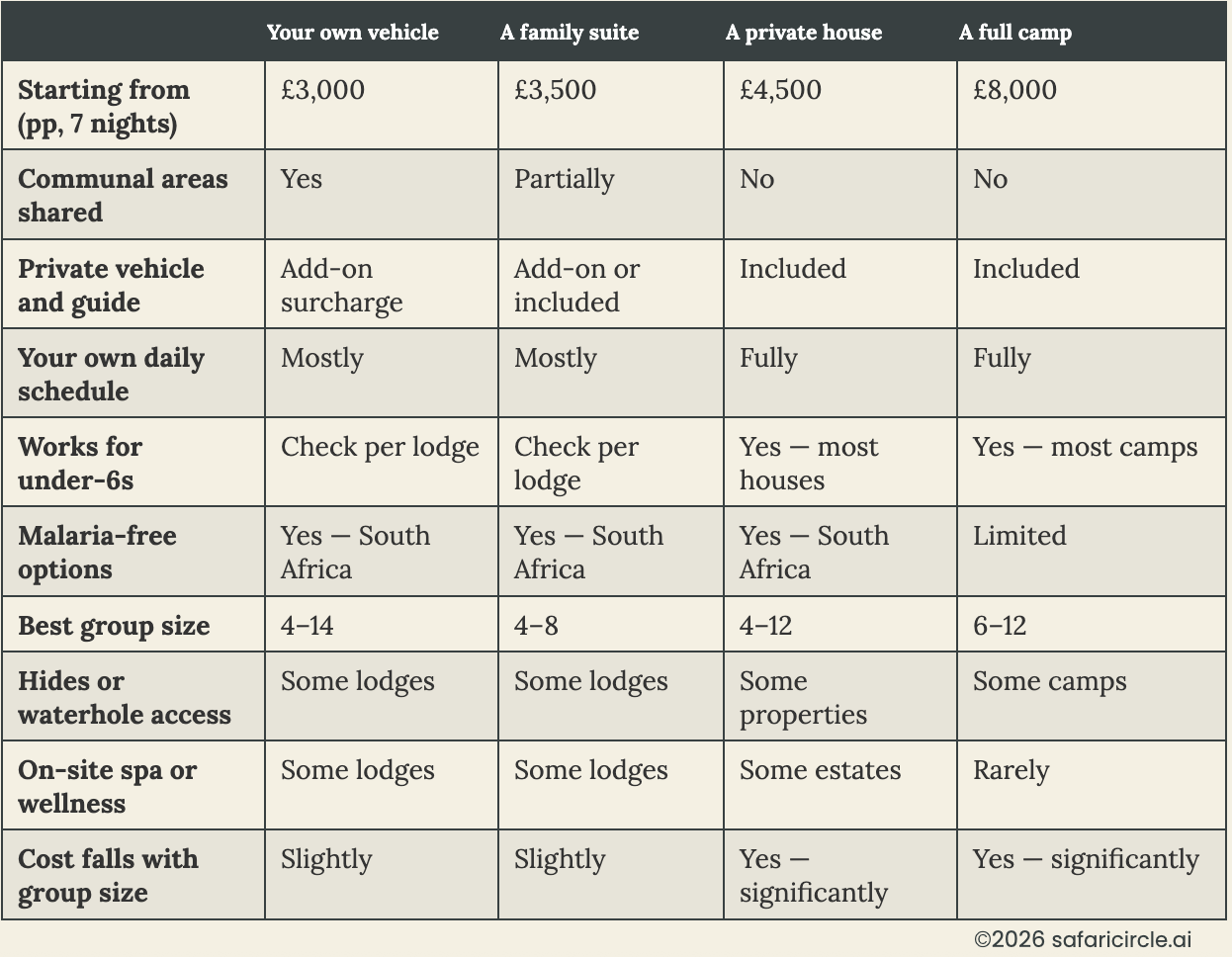
More accessible than most families expect and the per-person cost often improves as group size grows. Four accommodation models work well for multi-gen groups. The right one depends on how much privacy matters, how large the group is and how the trip should feel.
All prices below are per person, all-in for seven nights — accommodation, meals, game drives, park fees, and internal transfers. International flights are not included. Shoulder season (May to June and November for East Africa; May and September to October for Southern Africa) typically reduces costs by 15 to 20 per cent.
The most accessible starting point is a quality lodge with a private game drive vehicle
Your group books individual rooms or suites at an established lodge and adds a private game drive vehicle. The pool, restaurant, and lounge are shared with other guests, but every game drive is entirely yours. Your own vehicle, your own guide, your own schedule. You set the pace, younger children can head back to camp early and nobody waits for strangers to agree on a stopping time.
The best lodges for this model have more going on than just game drives. Look for properties with hides or waterhole platforms where a grandparent can sit quietly and watch elephants arrive at dusk without leaving the lodge at all. On-site activities matter equally: junior ranger programmes for children, bush skills workshops, guided walks and spa facilities for those who want a slower morning or a day enjoying the landscape from your camp. A well-designed lodge is not just a base between drives, it is somewhere three generations can each find their own version of the experience. Whilst we don’t often recommend larger style properties that feel more like a hotel than an intimate camp in the wild, for mult-generational families, larger properties may well offer more facilities and infrastructure that cater to the eldest and youngest members of your group.
Good for: Groups of 4–14 · Wide age and mobility range · First multi-gen safari · Full lodge infrastructure important
Properties to explore: Governors' Camp, Masai Mara, Kenya (private conservancy, hides, night drives) · Elewana Tortilis Camp, Amboseli, Kenya (waterhole, Kilimanjaro views) · Savute Safari Lodge, Botswana (waterhole beside the lodge, family chalet) · Phinda Mountain Lodge, South Africa (malaria-free, WILDChild programme, family cottages) ·Melia, Ngorongoro, Tanzania (family rooms, muilt-bed suites, pool, crater views) Four Seasons, Serengeti, Tanzania (private villas and standard rooms, waterhole, pool)
Interconnecting rooms or a private wing; sharing the lodge's communal facilities
Several lodges now build specific accommodation for multi-generational groups: interconnecting cottages, adjacent suites with a shared sitting area, or a private family wing with its own entrance. You share the lodge's communal spaces with other guests, but your family has a coherent private home base. Grandparents are not next door to strangers. Children have space to move. Parents have somewhere to sit together once the children are in bed.
The best properties in this category are thoughtful about what multi-gen means in practice: pathways that work for older travellers, menus that accommodate children, guides who know how to engage a 10-year-old and a 70-year-old on the same game drive. Some have dedicated hides or waterhole platforms at the lodge itself, so an elderly family member who wants to skip the afternoon drive can still have a genuine wildlife encounter, quietly watching whatever arrives at the water.
Good for: Groups of 4–8 · Families who want more coherence than standard rooms but not full exclusivity
Properties to explore: Wilderness Botswana camps (family suites, Bush Buddy programme for children 6–12) · Singita Grumeti, Tanzania (private suites, pool, spa, Mini Rangers Course) · Kings Pool Camp, Botswana (family suites, Linyanti wetlands) · Phinda Mountain Lodge, South Africa (cottages configurable as 3-bedroom family units, malaria-free)
Your own chef, your own vehicle, your own schedule — no other guests anywhere
A standalone house or villa within a game reserve, taken over entirely by your group. Your chef cooks when you are ready. Your guide takes you out when you want to go. There is no schedule to fit around, no dining room that closes at nine, no early wake-up call timed to strangers' preferences. This is the model that most multi-gen families settle on once they understand what it means in practice.
Private houses range from intimate two-bedroom cottages in South Africa's malaria-free reserves — all ages welcome, often with their own waterhole and bird hide — through to large estate properties on private conservancies in Kenya and Tanzania with swimming pools and access to activities the national parks do not permit: night drives, walking safaris, and dramatically fewer other vehicles. The conservancy setting is a significant advantage that is easy to underestimate. Mara Bush House, Sirikoi House, and Segera Retreat all sit on private land where guides can structure the day around your group rather than park regulations.
Per-person cost falls as the house fills. A four-bedroom house shared by ten guests costs meaningfully less per person than the same house with five. Filling the house is usually the single most effective way to make this model more accessible.
Good for: Groups of 4–12 · Full flexibility · Wide age and mobility range · Conservancy access important
Kenya properties: Sirikoi House, Lewa Conservancy (own chef, guide, vehicle; two cottages; rhino and wild dog) · Cottar's Bush Villa, Private Olderkesi Conservancy neighbouring Mara (5 ensuite rooms, private pool, boules lawn, massage room, own chef, guide and vehicle) · Nilotica Private House, Laikipia (4 suites, max 10 guests, private vehicle included) · Segera Retreat villas, Laikipia (camel, horse, and conservation activities alongside Big Five)
Tanzania and South Africa: Singita Serengeti House, Grumeti (pool, tennis, spa, migration access) · Jabali Private House, Ruaha (home-from-home in a rarely visited park) · Phinda Homestead, KwaZulu-Natal (4 bedrooms, all ages, WILDChild programme, malaria-free) · Melton Manor, Kwandwe (private chef, Eastern Cape Big Five, malaria-free)
A boutique safari camp taken over entirely by your group. Guides know every family member by name and preference within hours of arrival. The day is built entirely around you — when you eat, when you head out, what pace you move at, which activities suit which members of the group. The absence of other guests changes the atmosphere of a camp in a way that is difficult to articulate until you have experienced it.
This model suits groups whose priority is wildlife depth and full immersion. The best small camps sit in areas of extraordinary density — Namiri Plains in Tanzania's eastern Serengeti for predators, Wilderness Qorokwe in Botswana's Okavango Delta for the full water-and-land ecosystem, Singita Pamushana in Zimbabwe for rarity and comfort in equal measure. The economics improve significantly as the camp fills. The same camp taken over by ten or twelve guests costs substantially less per person than by six, and shoulder season rates can reduce costs further without any meaningful compromise on the experience.
Good for: Groups of 6–12 · Wildlife depth the priority · Full privacy · Adult-led or adult-focused multi-gen groups
Properties to explore: Namiri Plains, eastern Serengeti, Tanzania (8 tents; extraordinary predator density) · Wilderness Qorokwe, Okavango Delta, Botswana (water and land; experienced with multi-ability groups) · Singita Pamushana, Zimbabwe (exceptional comfort, Lake Mutirikwi, rare species) · Cottar's 1920s Camp, Kenya (Mara/Serengeti border; classic atmosphere)
One of the most common misconceptions about a multi-gen safari is that everyone has to participate in the same activities at the same time. They do not — and the best properties are designed around exactly this reality.
Hides, waterhole platforms, and elevated lookout points built into lodge grounds mean that a grandparent who wants to sit quietly at sunrise, or a young child who has had enough of the vehicle, can still have a genuine wildlife encounter. Elephants arriving at dusk, a family of warthogs crossing the clearing, a kingfisher perched ten feet away. These moments are often the ones people remember most clearly, precisely because they were unplanned and unhurried.
On-site activities matter as much as off-site ones for a group spanning four decades. Junior ranger programmes keep children engaged between drives. Bush skills workshops — fire lighting, tracking, navigation — work across age groups. Spa and wellness facilities give adults who want a slower afternoon somewhere to go. A chef who runs a cooking session with the grandchildren gives parents two hours of quiet. These are not optional extras; they are what makes the trip genuinely work for everyone in the group.
Own vehicle at a shared lodge
£3,000
£4,500
-
Most accessible option. Your group books rooms or suites at a quality lodge and adds a private vehicle, while sharing communal areas with other guests.
Family suite or private wing
£3,500
£5,000
£7,500
Interconnecting rooms, adjacent suites or a family wing within a lodge; better coherence for grandparents, parents and children without full exclusivity.
Private safari house or villa
-
£4,500
£8,000
Own chef, vehicle, guide and schedule. Best for groups of 4–12; per-person cost improves as the house fills.
Whole camp takeover
-
£8,000
£10,000+
Full privacy at a small camp of around 6–10 tents. Best for groups of 6–12 where wildlife depth and immersion matter most.
Prices are indicative per person for seven nights, including accommodation, meals, game drives, park fees and internal transfers, excluding international flights. Shoulder season can reduce costs by around 15–20%, and private vehicle surcharges may apply at shared lodges or family-suite properties.
Exclusive-use costs a meaningful premium. The difference between sharing a lodge and taking it over entirely can be £2,000 to £4,000 per person depending on group size and destination. For most multi-gen groups this trade-off is worth it — the flexibility and privacy transform the trip. But it should be understood before booking, not discovered during the planning process.
Mobility matters more than most families acknowledge at the outset. If grandparents have limited mobility, walking safaris, canoe excursions, and some lodge-to-lodge transfers are not practical. This narrows the destination and lodge shortlist, but it does not diminish the experience. The best lodges at the upper price tiers are designed for guests who want to watch and absorb as much as guests who want to walk and climb. Being specific about fitness levels early makes for a far better outcome than discovering constraints mid-trip.
Not all lodges are built for groups. Some of the most celebrated camps in Africa are intimate six-tent properties designed for couples — they can be taken exclusively, but the infrastructure is not calibrated for ten or twelve people. A dining table for eight and a game drive vehicle that holds seven is the wrong choice for a group of eleven. This is one of the most common planning errors, and one of the most easily avoided with the right guidance.
Children's minimum age varies by property and activity. Most bush camps across East and Southern Africa welcome children from the age of six — this is the market standard, not eight. South Africa's private reserves frequently have no minimum age at all, and private house bookings typically waive minimums entirely. A small number of more remote camps set their minimum at eight or twelve; these are the exception, not the rule, and your shortlist is built around your children's ages from the start.
‘The multi-generational safaris that work best share one quality: you get to set the pace, not the itinerary. When older travellers are freed from the pressure to keep up, and younger ones are given space to be genuinely curious rather than performatively engaged, something shifts. The bush has a way of making four decades of family history feel very present. The trips we see go wrong are almost always the ones where the accommodation was wrong — not the destination.’
For groups that include older travellers, the dry season is the non-negotiable starting point - not only for wildlife reasons, but because dry conditions make transfers easier, roads are passable and the cooler mornings are more comfortable. In East Africa this means July to October. In Southern Africa it means May to October.
If the group includes school-age children in UK education, July and August align well with the East African & South Africa’s dry season. October half-term is a strong second option for Kenya and Tanzania, where game viewing remains excellent and lodge rates ease from the August peak.
Book exclusive-use properties 12 to 18 months ahead of your intended window. The camps and houses that work best for large multi-gen groups are limited in number and book out well in advance of peak season. Availability, not price, is the binding constraint.
For most multi-generational groups, exclusive-use is not a luxury — it is what makes the trip work. When three generations share a camp with strangers, every schedule decision becomes a negotiation between your family's needs and other guests'. With exclusive-use, your guide learns the group within hours, activities can split by age and interest simultaneously, and the pace is entirely yours. For groups of six or more, the per-person premium over a standard lodge booking is often smaller than families expect — particularly when exclusive-use safari houses designed for 10 to 12 guests are considered.
Most bush camps across East and Southern Africa welcome children from the age of six — this is the market standard. South Africa's private reserves frequently have no minimum age, and private house bookings typically waive minimums entirely. Kenya has no national minimum age, though individual lodges set their own policies; most welcome children from six upwards. A small number of more remote camps in Tanzania and Botswana set minimums of eight or twelve for game drives. The minimum age question is one of the first things to establish when building your shortlist.
Yes — with the right lodge and destination. Open 4x4 game drives are accessible to most guests regardless of mobility; the practical question is whether transfers between lodges and airstrips are manageable. The best lodges at the upper price tiers are designed for guests with varying physical abilities — flat camp layouts, high-quality bathrooms, and staff who understand how to support older guests without making mobility a source of self-consciousness. Walking safaris and canoe excursions are not suitable for guests with significant mobility limitations but they are rarely the centrepiece of a multi-gen trip.
For a group of eight taking over an exclusive-use camp in Kenya or Tanzania at the mid-range tier, the all-in cost for seven to ten nights — accommodation, meals, game drives, park fees, and internal transfers — typically falls between £65,000 and £90,000, excluding international flights. Per-person costs fall as group size grows, because exclusive-use pricing at safari houses and small camps is often near-fixed regardless of whether the property is occupied by six or twelve guests. Verify specific figures with your operator before committing.
Twelve to eighteen months ahead for peak season travel is the honest answer for exclusive-use properties. The camps and houses that work best for large multi-gen groups are limited in number, and the best at the best destinations book out consistently well in advance of July, August, and December. Booking early is not about securing a price advantage — it is about having access to the options that will make the trip genuinely work for your group.
For some groups, yes — particularly if older teenagers or young adults are part of the trip and the safari alone feels too short. East Africa offers the most practical combination: Kenya pairs naturally with the Seychelles or Zanzibar, Tanzania with Zanzibar. The contrast between total bush immersion and several days at a beach property works well for groups with different energy levels and interests. For groups where the safari is the point, it is usually worth keeping the itinerary focused.


As an independent partner of 360 Private Travel, eligible flight-inclusive holidays booked through us are financially protected by 360 Private Travel Ltd under the UK ATOL scheme, ATOL number 7514. 360 Private Travel Ltd is also IATA accredited under IATA number 91200056.
Qualifying flight-inclusive holidays are financially protected under the UK ATOL scheme, where applicable. You will receive an ATOL Certificate confirming the protection covering your individual booking.



.png)
