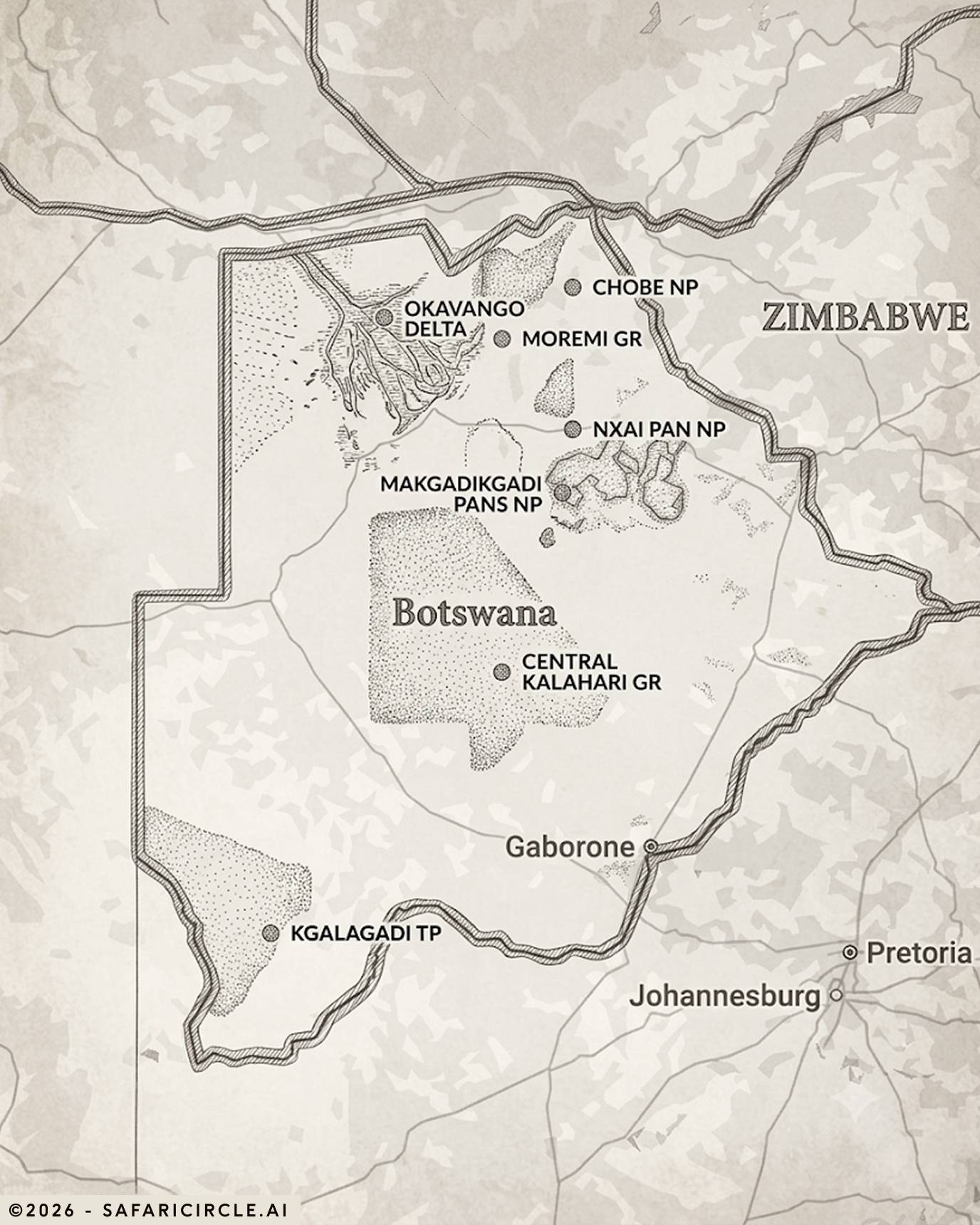
Major Safari Regions
Available Lodges
Peak Season
Price Range (per person)
Botswana is Africa’s most exclusive safari destination — and the only one where water defines the experience as much as wildlife. The Okavango Delta’s annual flood turns the northern Kalahari into a vast inland waterway from June to October, creating a safari you navigate by mokoro, motorboat, and open 4x4 in a single day. I’ve been poled through lily-covered channels at dawn and tracked wild dog across Linyanti’s floodplains at dusk — no other country delivers both in one trip. Six regions span flooded delta, elephant-dense riverfront, predator-rich savannah, and the surreal salt pans of the Makgadikgadi. For returning safari travellers, honeymoon couples, and milestone celebrations, Botswana rewards those willing to pay for genuine solitude.
Botswana works year-round, but the experience changes dramatically by season — and by region.
June to October is peak season. The Okavango floods are at their highest, wildlife concentrates around permanent water, and the Delta’s water-based activities — mokoro, boat safaris — are at their best. This is also when Botswana is at its most expensive. The best camps book 12–18 months ahead.
May is the most underrated month. Flood waters are arriving, game viewing is already excellent, and rates sit at shoulder-season levels. Winter light is sharp and clean for photography.
January to March is green season — and the best time for the Kalahari and the Makgadikgadi zebra migration. Delta water levels are at their lowest, limiting mokoro activities. But rates drop 30–50% at premium camps, and the birding is extraordinary.
For UK families: July–August school holidays align with peak Delta season. October half-term catches the tail end of the dry season. Easter falls in the variable late-green period — the Kalahari and Makgadikgadi are better bets than the Delta in April.

Botswana offers more safari formats in a single trip than any other destination. Game drives in open 4x4s are standard across all regions. Mokoro (dugout canoe) safaris operate in the Delta and Linyanti when water levels allow. Motorboat safaris run on the Chobe River, Okavango channels, and Linyanti waterways. Walking safaris operate in private concessions — minimum age typically 12–16 depending on the property.
Night drives with spotlights are permitted in private concessions but not national parks or Moremi. Horseback safaris are available at select properties in the Delta and Tuli. Helicopter scenic flights offer aerial views of the Delta’s fractal channels. Quad biking across the Makgadikgadi salt pans is a uniquely Botswanan experience

.jpg)
Botswana is the most expensive safari destination in Africa. A Safari Circle Botswana itinerary typically costs £12,000–£20,000 per person for 7–10 nights. That includes accommodation on a fully inclusive basis, park and concession fees, game activities, internal bush flights between camps, and all meals and drinks.
The high-cost/low-volume model is deliberate. Botswana’s government caps visitor numbers to protect wilderness quality. Camps are small — rarely more than 16 guests — and many are fly-in only. You pay for solitude, exclusivity, and multi-format safari activity that no other country matches.
Not included: international flights (London–Maun via one connection, approximately £600–£900 economy return), travel insurance, and gratuities. No visa is required for UK citizens.
Green season (January–March) rates drop 30–50% at many premium camps. Staying within one operator’s camp portfolio — Wilderness, andBeyond, Great Plains — often unlocks complimentary inter-camp flights and long-stay discounts.
Returning safari travellers: If you’ve done the Mara or the Serengeti, Botswana’s water-based safari, wild dog encounters, and camp exclusivity offer something qualitatively different.
Honeymoon couples: Intimate camps with four to eight tents, star beds, private mokoro excursions, and no other guests at dinner. Botswana is safari romance without the beach compromise — extend to Mozambique or the Seychelles for Indian Ocean downtime.
Milestone celebrations: Exclusive-use camps like Zarafa (8 guests) or Little Mombo (8 guests) accommodate small groups in total privacy. A 50th birthday in the Delta is a different proposition from anywhere else in Africa.
Families with teenagers: Private concessions offer walking safaris, mokoro, and horseback riding that give 12–17 year-olds variety beyond game drives. The cost barrier is real — Botswana family safaris sit at the top of the budget range.
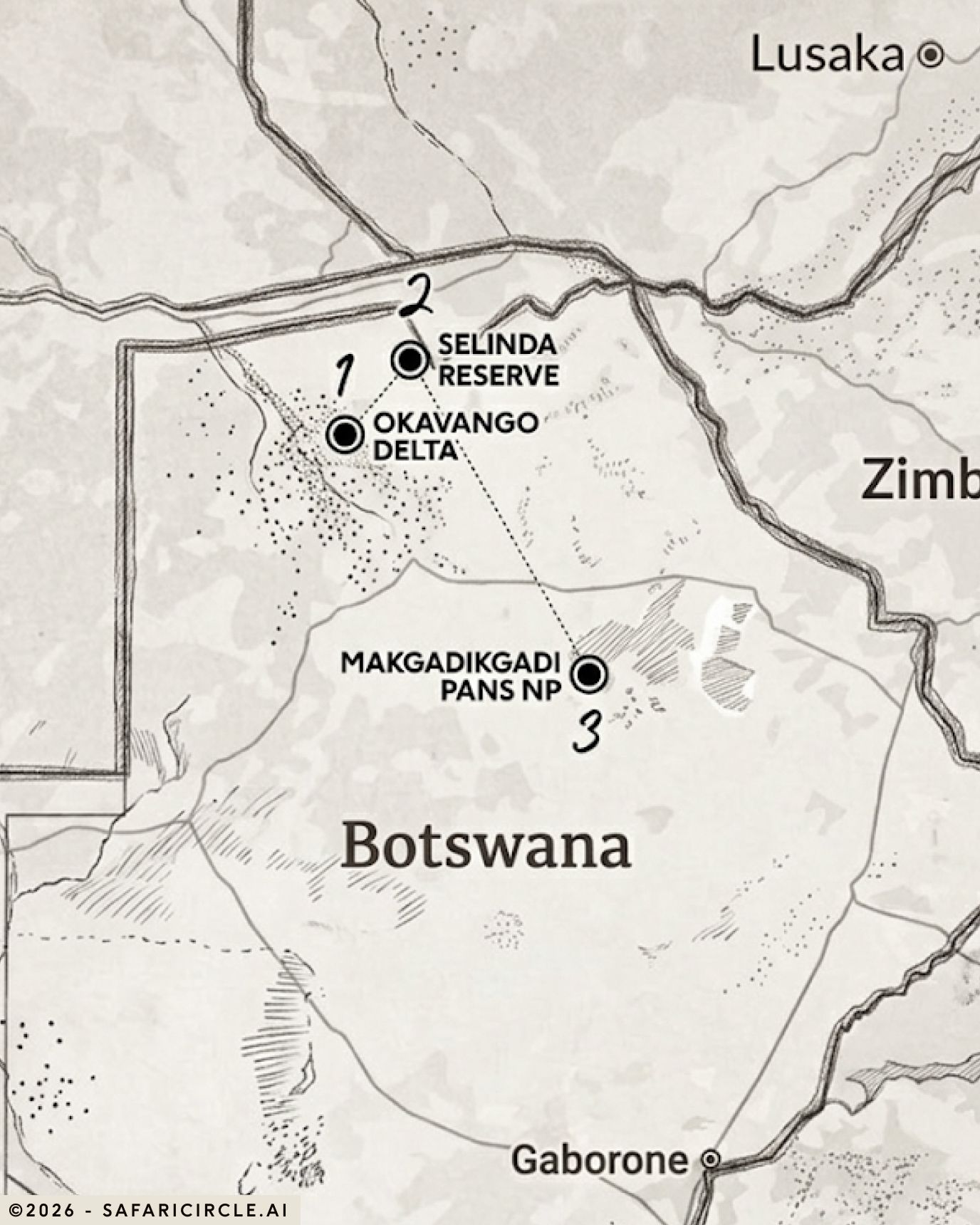
9-night Botswana highlights: Okavango Delta → Linyanti → Makgadikgadi
Wilderness Mombo, Chief’s Island — predator game drives, rhino tracking, bush brunch on the floodplain.
Great Plains Zarafa Camp, Selinda Reserve — boat safaris, walking, wild dog tracking, star bed sleep-out.
Jack’s Camp, Makgadikgadi Pans — meerkat encounters, quad biking across the salt pans, San Bushmen cultural walk.
UK citizens do not need a visa for stays up to 90 days. Your passport must be valid for at least six months after arrival and have at least three blank pages. If travelling with children under 18, you must carry original birth certificates — Botswana enforces this strictly.
Botswana is one of Africa’s most stable democracies with a strong safety record in all safari regions. The UK FCDO provides specific travel advice that Safari Circle monitors continuously.
Yes. Victoria Falls is a 90-minute drive from Kasane, the gateway to Chobe National Park. Most travellers add two to three nights at the Falls at the start or end of a Botswana safari. The Zimbabwe side offers the best views of the Falls themselves.
A yellow fever vaccination certificate is required only if arriving from a country classified as at risk of yellow fever transmission. Botswana is a malarial area — prophylaxis is strongly recommended for all safari regions. Consult a travel health clinic at least 6–8 weeks before departure
Seven nights is a realistic minimum for a Delta-focused trip. Nine to ten nights allows you to combine Delta, Linyanti or Chobe, and the Makgadikgadi for genuine variety. Shorter trips of three to four nights work for a Chobe-only itinerary combined with Victoria Falls.

As an independent partner of 360 Private Travel, eligible flight-inclusive holidays booked through us are financially protected by 360 Private Travel Ltd under the UK ATOL scheme, ATOL number 7514. 360 Private Travel Ltd is also IATA accredited under IATA number 91200056.
Qualifying flight-inclusive holidays are financially protected under the UK ATOL scheme, where applicable. You will receive an ATOL Certificate confirming the protection covering your individual booking.



.png)