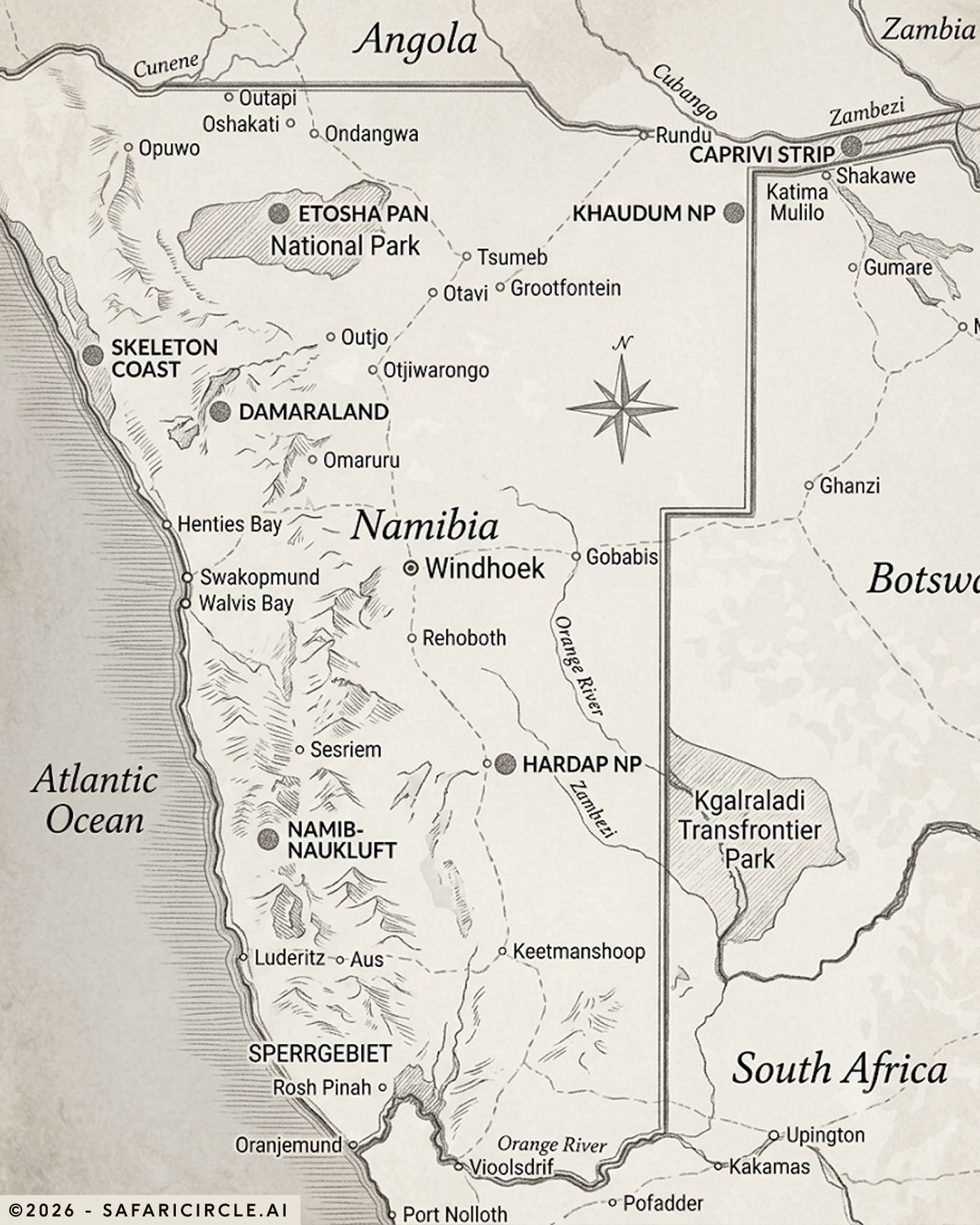
Major Safari Regions
Available Lodges
Peak Season
Price Range (per person)
Namibia is a landscape safari first, a wildlife safari second - and the only African destination where the terrain itself is the main character. No direct flights from the UK, no Big Five checklist, no green savannah. What you get instead is the world’s oldest desert, dunes that rise 300 metres from the valley floor, a coastline littered with shipwrecks, and wildlife that has evolved to survive where nothing should. Imagine climbing Sossusvlei’s dunes at dawn, tracking desert-adapted rhino on foot in Damaraland, and falling asleep to absolute silence at a Skeleton Coast camp with no other guests for 50 kilometres. Six regions span red desert, volcanic plains, salt pans, and a coastline where the Namib meets the Atlantic. For returning safari travellers, photography-minded couples and families with teenagers who need more than a game drive, Namibia delivers something no other country can replicate.
May to October is the dry season and the strongest window for Etosha game viewing. Waterholes concentrate wildlife, vegetation is sparse, and temperatures are comfortable during the day but cold on early-morning drives. This is peak season - the top camps book 6–12 months ahead.
April and November are the shoulder months worth knowing about. Etosha’s game viewing is already strong, lodge rates drop, and the light is clean for photography. Sossusvlei and the Skeleton Coast work year-round as the desert doesn’t follow a wet-dry cycle in the same way.
December to March is green season in the north. Etosha’s pan can flood, attracting flamingos. Daytime temperatures exceed 35°C. Some roads become difficult. Rates drop 20–40% at many properties.
For UK families: July–August school holidays align with peak dry season. October half-term catches excellent late-dry conditions. Easter falls in the shoulder–green transition — Sossusvlei and the Skeleton Coast are more reliable than Etosha in April.

Namibia’s safari formats differ from East and Southern Africa. Game drives run in Etosha’s private reserves and Okonjima. Walking safaris, including multi-day rhino tracking in Damaraland, operate in private concessions. Minimum walking age is typically 12–16.
Fly-in safaris by light aircraft connect camps across vast distances, turning travel time into a scenic experience over desert, coast, and volcanic terrain. Hot air balloon flights operate over Sossusvlei. Quad biking, sandboarding, and kayaking with Cape fur seals are available in the Swakopmund–Walvis Bay corridor.
Self-drive is a distinct format here — Namibia’s road network and lodge infrastructure make it viable in a way few African countries can match. A word of caution: the UK FCDO notes that accidents are common on gravel roads. Distances between lodges can exceed 300 kilometres. Night driving is strongly discouraged by every operator and advisory body. If you want the independence of self-drive, plan conservatively, take a full briefing from your rental company, and never drive after dark. For travellers who prefer not to drive, fly-in and privately guided safaris remove the risk entirely.

.jpg)
A Safari Circle Namibia fly-in itinerary typically costs £10,000–£18,000 per person for 10–14 nights. That includes accommodation on a full-board or fully inclusive basis, internal flights between camps, park fees, and guided activities.
Namibia spans a wider price range than Botswana or Rwanda. Fly-in camps at the exclusive tier — Serra Cafema, Little Ongava, Hoanib — command £1,000–£2,500+ per person per night. A self-drive itinerary with luxury lodges can sit at £8,000–£12,000 per person, though the driving commitment is substantial.
Not included: international flights (London–Windhoek via one connection, approximately £450–£750 economy return), travel insurance, visa on arrival (N$1,600 / approximately £66–88), and gratuities.
Returning safari travellers: If you’ve done East Africa’s game-drive circuit, Namibia’s terrain - desert tracking, fly-in camps, Skeleton Coast solitude - is a fundamentally different register.
Honeymoon couples: Star beds in the desert, private fly-in camps with four tents, and NamibRand’s Dark Sky Reserve make Namibia a honeymoon that trades beach for vastness.
Families with teenagers: Quad biking, sandboarding, dune climbing, kayaking with seals, and rhino tracking give 12–17 year-olds something a game drive never can. Namibia is an activity safari, not a sit-and-watch one.
Milestone celebrations: Exclusive-use properties like Serra Cafema (max 16 guests) or Little Ongava (max 6 guests) offer the kind of privacy that a 50th birthday in the desert demands.
.jpg)
10-night Namibia highlights: Sossusvlei → Damaraland → Skeleton Coast → Etosha
Wilderness Little Kulala, Sossusvlei — dawn dune excursion, Dead Vlei, desert nature drives, rooftop star bed.
Wilderness Desert Rhino Camp, Damaraland — rhino tracking on foot with Save the Rhino Trust, Twyfelfontein rock engravings.
Wilderness Hoanib Skeleton Coast Camp — desert-adapted elephant and lion, Skeleton Coast excursion, Himba community visit.
Little Ongava, Etosha — Big Five game drives, private waterhole hide, night drives on Ongava Reserve.
Yes. Since April 2025, UK citizens require a visa on arrival or an e-Visa applied for in advance. The fee is N$1,600 (approximately £66–88). Apply online at eservices.mhaiss.gov.na before travel to avoid delays at immigration. Your passport must be valid for at least six months with at least two blank pages. If travelling with children under 18, carry original birth certificates — Namibia enforces this.
Namibia’s safari regions have strong safety records. The UK FCDO advises exercising caution primarily around urban petty crime in Windhoek and road safety on gravel roads. Road accidents involving single vehicles are common — gravel, long distances, and fatigue are the main risks. For safari travellers using fly-in or guided formats, these risks are largely eliminated. Safari Circle monitors FCDO advisories continuously.
It depends on the region. The Caprivi Strip, Kavango, and Kunene river regions carry high malaria risk year-round. Etosha has a moderate risk during the wet season (November–June). Sossusvlei, the Skeleton Coast, NamibRand, and central/southern Namibia are very low to no risk. Consult a travel health clinic at least 6–8 weeks before departure.
Yes. Cape Town is a natural pairing — flights from Windhoek to Cape Town take around two hours. A Namibia fly-in safari followed by three to four nights in Cape Town and the Winelands is a strong combination. Victoria Falls is reachable via the Caprivi Strip or a short flight. Botswana’s Okavango Delta pairs well for travellers wanting both desert and water safari.
Ten nights is a realistic minimum for a fly-in circuit covering Sossusvlei, Damaraland or the Skeleton Coast, and Etosha. Fourteen nights allows a more comprehensive route including NamibRand and Okonjima. Self-drive itineraries typically need 12–16 nights to cover the distances comfortably without rushing.

As an independent partner of 360 Private Travel, eligible flight-inclusive holidays booked through us are financially protected by 360 Private Travel Ltd under the UK ATOL scheme, ATOL number 7514. 360 Private Travel Ltd is also IATA accredited under IATA number 91200056.
Qualifying flight-inclusive holidays are financially protected under the UK ATOL scheme, where applicable. You will receive an ATOL Certificate confirming the protection covering your individual booking.



.png)