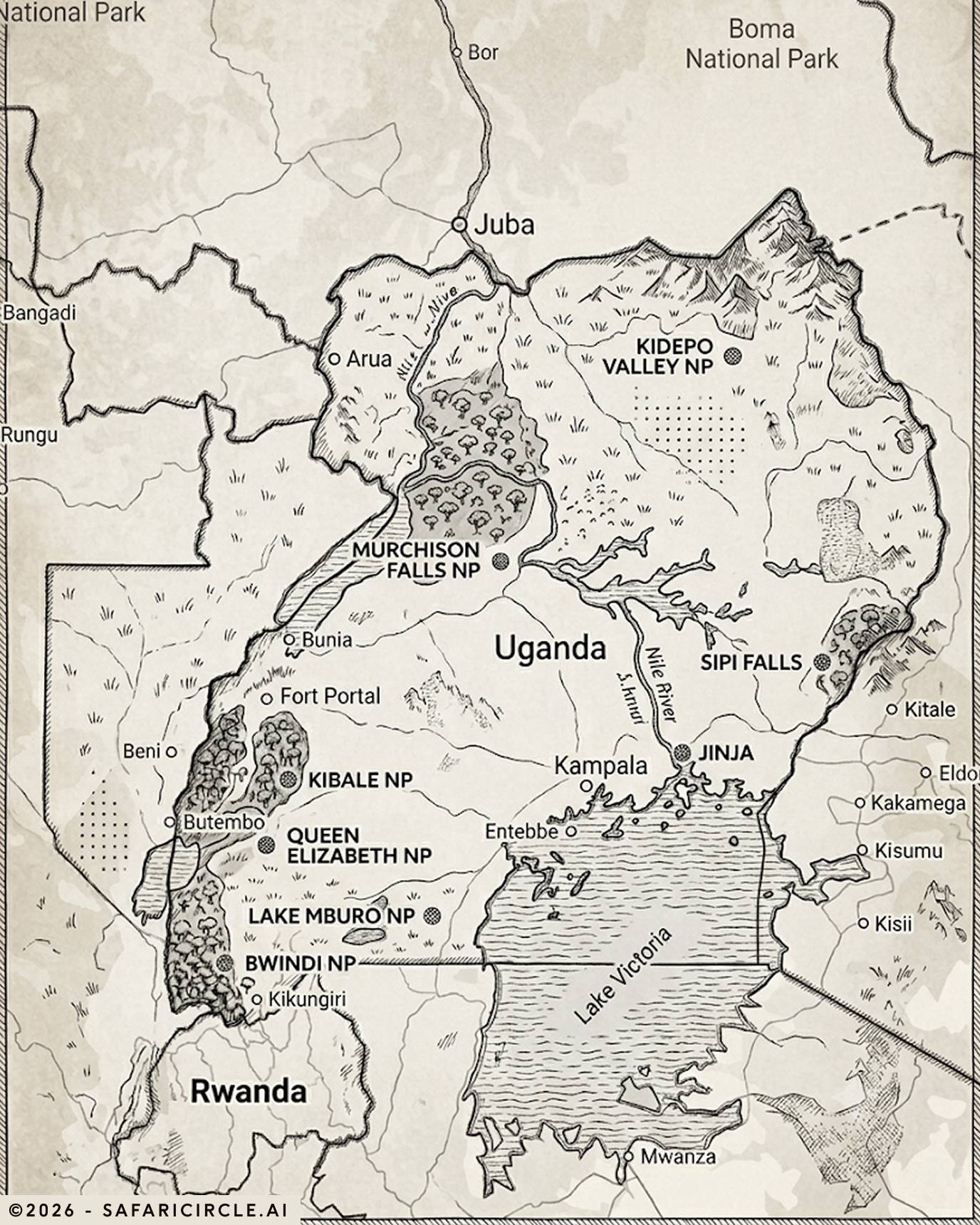
Lake Mburo National Park is Uganda’s compact savannah counterpoint to the country’s forests and primates. Close enough to Kampala or Entebbe to work as a smart route stop, it offers zebra, impala, walking safaris, boat trips and horseback riding in a softer, more relaxed wildlife setting.
Lake Mburo and wetland edge
The lake and its surrounding wetlands bring hippos, crocodiles, waterbirds and boat-based perspective to the park. This is where Lake Mburo feels most distinct from Uganda’s forest parks, with water, papyrus and open views shaping a gentler safari rhythm.
Acacia savannah and grazing plains
The park’s acacia woodland and open plains are the best places to look for zebra, impala, eland, topi, buffalo and giraffe. The landscape feels manageable rather than overwhelming, making it a useful introduction or decompression stop within a longer Uganda route.
Private ranchland and activity areas
Some of the strongest Lake Mburo experiences sit around the park’s edge, where lodges use nearby private land for walking, cycling or horseback safari. These activities give the area a more active, personal style than many vehicle-only destinations.
Lake Mburo is best known for zebra, impala, eland, buffalo, giraffe, hippo, crocodile and excellent birdlife, rather than heavy predator drama. Leopards are present but elusive, and lions are not the park’s main story. The appeal is variety, approachability and activities that let travellers experience savannah without constant vehicle time.
Uganda sits on the equator and is a year-round destination. Gorilla permits are available every day. Two dry seasons shape the calendar.
June to September is the primary dry season and the best window for gorilla trekking — trails are less muddy, the forest floor is firmer, and trekking times tend to be shorter. This is also peak season for Murchison Falls and Queen Elizabeth.
December to February is the secondary dry season. Gorilla trekking is excellent, and savannah game viewing is strong. February is the most underrated month — fewer visitors than July–August, good conditions across all parks, and gorilla permits are easier to secure.
March to May brings the heaviest rain. Some roads become difficult, and gorilla treks are harder. But green-season rates drop, birding is at its peak (Uganda has over 1,000 bird species), and the landscape is lush.
For UK families: July–August school holidays align with the primary dry season. October half-term falls in a shoulder period — conditions are variable but permits are more available. Easter sits in the wet season and is less reliable.

Lake Mburo is not an international lodge-awards hotspot, but it is widely valued by Uganda specialists for doing something specific and useful. It adds savannah, zebra and active safari experiences to itineraries otherwise dominated by gorilla, chimp and forest travel.
Its acclaim is practical rather than glamorous. For travellers moving between Entebbe, Kampala, Bwindi, Queen Elizabeth or Kibale, it can turn a transfer corridor into a genuine wildlife stop with its own pace and identity.
Lake Mburo suits travellers who want Uganda to include more than primates. It is a gentle savannah stop for first-timers, families with older children, active travellers and anyone who enjoys walking or riding as part of safari.
It is especially useful for itineraries that need a softer beginning or end. After gorilla trekking or long road journeys, Lake Mburo can feel open, calm and refreshingly easy.
Serious big-cat seekers should treat it as a complement, not the centrepiece. Its value lies in activity variety, scenery and relaxed wildlife rather than intense predator encounters.
From the UK, travellers usually fly into Entebbe International Airport, then travel by road through Uganda with a private driver-guide or specialist operator.
Lake Mburo is one of Uganda’s more accessible safari parks, commonly reached by road from Entebbe or Kampala, and often used en route to or from the western circuit.
Light aircraft routing is possible in some Uganda itineraries, but Lake Mburo is most often included as a road-based stop because its location works naturally within overland safari planning.
One or two nights can work well, depending on the wider Uganda route. Two nights allows time for a game drive, boat trip and a walking or riding activity without making the stop feel purely logistical.
Lake Mburo can be visited year-round, though drier months generally make wildlife viewing and road conditions easier. Wet months can be greener and very attractive for birdlife, but some activities may be more weather-dependent.
Yes, with the right lodge and age mix. The park’s manageable scale, varied activities and gentle wildlife make it appealing for families, especially with older children who can enjoy walking, riding or boat-based safari.
Lake Mburo is especially known for zebra, impala, eland, buffalo, giraffe, hippo, crocodile and birdlife. It is not a major lion destination, so travellers should choose it for variety and atmosphere rather than predator density.
Yes. Lake Mburo often fits naturally into a Uganda route before or after Bwindi, Queen Elizabeth or Kibale. It adds savannah wildlife and active safari experiences to an itinerary otherwise focused on forests and primates.
The main trade-off is that Lake Mburo is charming rather than epic. It is excellent for a softer, more active safari stop, but travellers wanting dramatic big-cat action should place that expectation elsewhere in the itinerary.

Some of the flights and flight-inclusive holidays booked with Safari Circle are financially protected by the ATOL scheme. If you don’t receive an ATOL certificate, the booking will not be ATOL protected. In the unlikely event of our insolvency, the Civil Aviation Authority (CAA) would ensure that you’re not stranded abroad. They will also arrange to refund any funds you have already paid us towards your booking. You can verify our ATOL status on the Civil Aviation Authority website. Please note, we operate as independent partners to Major Travel (ATOL 2933)
ABTA act as a trade association (both commercial & regulatory) for travel agents and tour operators in the UK. As independent partners to Major Travel, all of our bookings at Safari Circle that contain hotels, tours or car hire but do not include international flights are protected under Major Travel’s ABTA Bond. In the unlikely event of an unresolved dispute between you as a passenger and us/Major Travel, you can use the ABTA arbitration service as an alternative to legal action. You can verify our ABTA number (Y6455, P7169) on the ABTA website.
.png)