

Twelve is the age that unlocks the full safari. Walking safari where you move through the bush on foot with an armed guide and tracker, reading animal signs, learning to communicate in silence – all become available at most camps from twelve or thirteen. This is the single biggest unlock. Being at eye level with the landscape rather than watching from a vehicle changes the experience fundamentally.
But walking is only the beginning. Fly-camping opens up at the same age, sleeping under the stars with nothing between you and the sky. Mokoro (canoe) safaris through the Okavango Delta, paddling in silence past hippos and elephants. Horseback riding and camel treks across private conservancies. Gorilla and chimpanzee trekking in Rwanda, Uganda, and Tanzania. Conservation work with real stakes: tracking collared animals, clearing snare lines, monitoring wildlife populations. These are not curated activities designed to keep children busy. They are experiences that would be unsafe or impractical with a younger child and they are the reason teenagers often engage with safari more deeply.
There is a certain joy in seeing concepts confined to textbooks suddenly come to life for your kids. The biology that felt abstract in a classroom suddenly has a heartbeat: predator-prey dynamics visible in real time, symbiotic relationships on every oxpecker, the water cycle written into a dry-season riverbed. Economics becomes tangible when a guide explains how conservancy fees fund anti-poaching units. Geography, ecology, history — subjects that existed behind a textbook cover are suddenly playing out in front of your teenager and they are paying attention in a way that no classroom has managed.
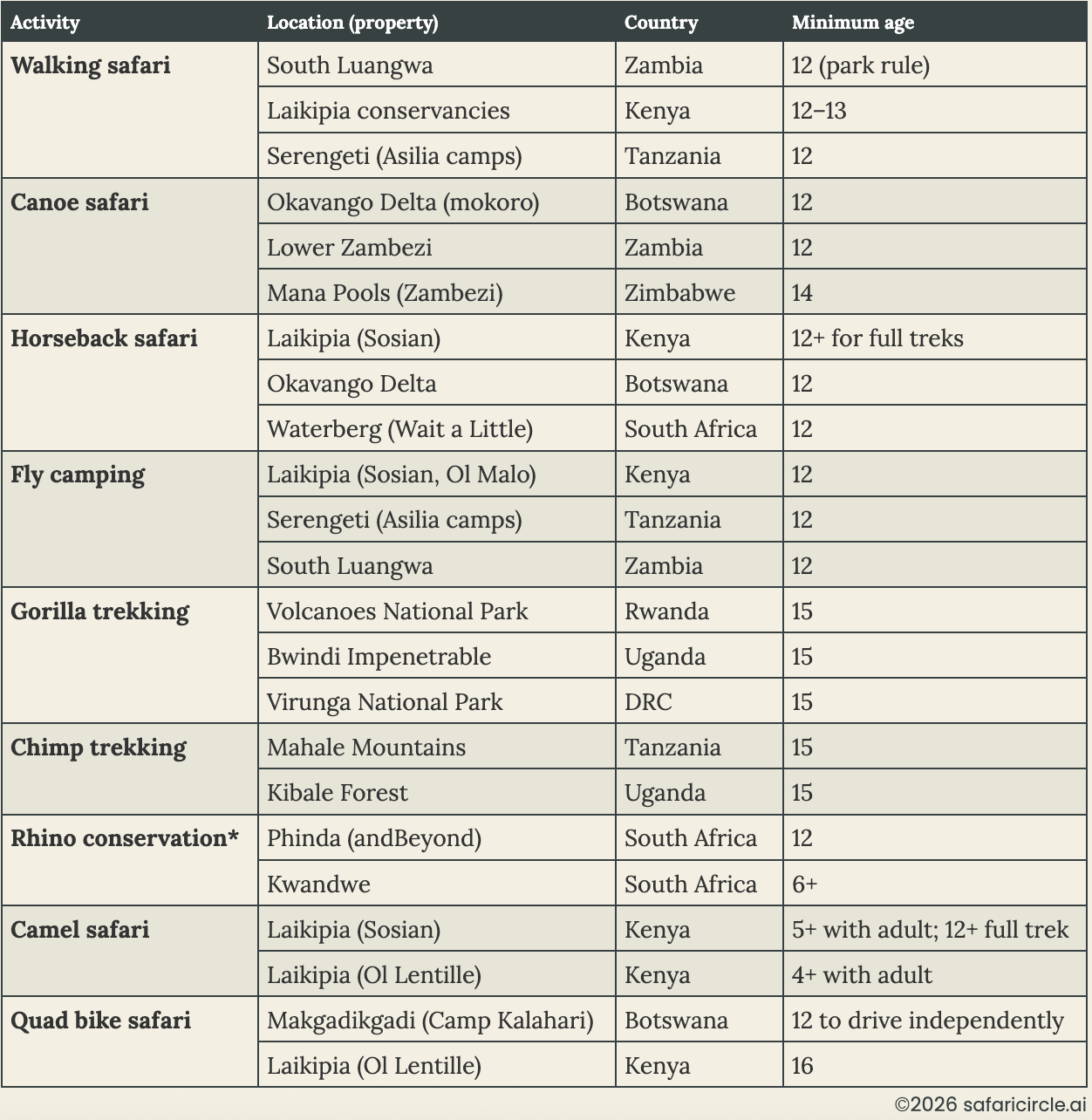
*Rhino conservation experiences include ear notching, horn notching, ear notch reading, dehorning, and microchipping. Currently available at select South African private reserves only.
This is not about ranking countries. It is about matching the destination to the kind of teenager you have.
The widest activity portfolio for teenagers anywhere in Africa. Horse riding, camel treks, helicopter flights, hands-on conservation work and walking safaris from twelve at most properties. Laikipia’s private conservancies are the strongest option: Sosian Lodge accepts children of all ages, breeds its own horses including ponies for younger riders and includes walking, camel treks, fly-camping, and night drives in the rate. Ol Malo on the northern escarpment adds deep Samburu cultural immersion and a leopard hide where your teenager can spend the night. The Mara conservancies add Big Five game viewing with walking and night drives the national reserve does not permit. Kenya is the strongest choice for the teenager who needs physical challenge and a sense of being part of something rather than watching it.
The Great Migration creates a sense of awe that cuts through teenage composure in a way very few experiences can. Walking safaris are available from twelve at Asilia’s camps: Namiri Plains in the eastern Serengeti for big cat encounters, Oliver’s Camp in Tarangire for elephants and baobab forests. Tanzania’s teen activity range is narrower than Kenya’s with fewer horse and camel options but the wildlife intensity compensates.
The birthplace of walking safaris. South Luangwa’s minimum age for walking is twelve – this is a park-wide regulation. Time + Tide Chinzombo offers the most comfortable base: six villas on the Luangwa River, private plunge pools, and guiding among the finest on the continent. The experience is rawer than East Africa’s polished conservancies. A teenager who would rather sleep in a fly-camp than beside a swimming pool will find their version of safari here.
The most logistically straightforward choice, with malaria-free reserve options. Three or four nights in the Sabi Sand followed by Cape Town works well for teenagers not yet sure whether a full week of safari is for them. South Africa is also a strong option when your family includes a younger child alongside a teenager.
Learn more about South Africa →
The Okavango Delta adds a dimension no other destination offers. Mokoro canoe safaris, gliding through papyrus channels at water level, elephants wading alongside, are available to teenagers but not practical with young children. Best for the teenager who responds to landscapes and quiet immersion rather than pure adrenaline.
An eight-year-old and a fifteen-year-old need fundamentally different things from a safari day. The key is a property where the day can split: your teenager goes on a walking safari or horse ride while your younger child stays in camp with a junior ranger programme. They come back together for lunch with different stories.
Laikipia’s conservancies handle this well — the guide team can run separate activities simultaneously. In South Africa, andBeyond Phinda Mountain Lodge runs its WILDchild programme for children from age three upwards, so your younger child is on a bush skills workshop or a short game “bumble” while your teenager is tracking rhino on foot. Exclusive-use properties solve this particularly well: when the lodge belongs to your family, every activity calibrates to each child’s age without negotiation.
Learn more about Family Safari →
Long full-day drives without a break. Even teenagers who love safari sometime need two shorter drives with a meaningful mid-day programme (swimming, bush skills, time to process) rather than one six-hour marathon.
Camps where teenagers are treated as either small adults or large children. The best guides calibrate: they ask questions rather than lecture and let the teenager set the pace of their own curiosity. A good dose of humour to still engage the big child in them.
Very intimate couples-focused camps where your teenager is the only person under forty won’t work. It changes the atmosphere for everyone. Choose a property that genuinely welcomes families, not one that technically permits them.
Destinations with no activity variety beyond vehicle-based game drives. The real advantage of travelling with teenagers is that so much more opens up from walking safaris, canoe safaris, cultural visits to photography sessions and horse riding. If you are choosing a destination or lodge, look for the ones that let you build variety into each day rather than repeating the same format especially if you’re there more than two nights.
One honest conversation to have before you go: predator-prey interactions. A kill is real. Some teenagers find it thrilling; some find it distressing. Discussing this before the trip, not in the vehicle, makes the experience better for everyone.
Not every teenager wants the same safari. Some need adrenaline and physical challenge. Others will sit for an hour watching a leopard in a tree and come back with questions the guide has never been asked. Understanding which version will land is what makes the difference between a trip they tolerate and one they never stop talking about. That is what Safari DNA helps clarify, and it is the first thing we explore when a family gets in touch.
The post-exam window matters more than the destination. Teenagers who travel in late June or July, immediately after GCSEs or A-Levels, arrive in a state of mind that is uniquely receptive. They have just finished something hard. They are ready to feel something big. The combination of physical freedom, sensory immersion and the complete absence of academic pressure creates a mental space where safari lands at its deepest. If you can time the trip to that window, do.
A teenage family safari typically sits in the £4,500–£8,000 per person range for seven to ten nights, depending on destination and lodge tier. Most lodges charge the full adult rate from age twelve, which catches some families off guard. However, a number of leading operators extend discounted child rates into the teenage years: andBeyond offers 50% off for children under sixteen sharing with adults; Wilderness applies a child rate up to and including age sixteen, with discounts of 35–65% depending on season; and Asilia currently offers one child under eighteen free when sharing with an adult. Time + Tide charges children aged four to seventeen at 50% of the adult rate. These offers can meaningfully reduce the per-person cost — it is always worth asking what child or young adult rates apply before assuming the full adult figure. Our family safari page covers detailed pricing by configuration.
‘The teenage safaris that work best share one quality: the parents stopped trying to sell the trip and let the bush do the talking. When a fifteen-year-old chooses to wake up at five because they want to, not because they were told to, something has shifted. When they ask the guide a question you did not expect, you realise the trip has become theirs, not yours. That is the moment.’ — Safari Circle curation team
July and August align with peak dry season across East Africa – the strongest wildlife viewing coupled with the highest rates. October half-term is the underrated alternative: excellent game viewing, quieter camps, noticeably lower prices. The post-exam window in late June and early July is particularly strong for availability and teenage receptiveness. For South Africa, Easter and May half-term coincide with autumn conditions. Book nine to twelve months ahead for peak season. The activity-rich camps that work best for teenagers in peak season fill quickly.
What is the minimum age for a walking safari? Twelve at most camps across East and Southern Africa. In South Luangwa, twelve is a park-wide regulation. In Kenya and Tanzania, it varies by property — most set the minimum at twelve or thirteen, at the guide’s discretion.
Will my teenager be bored on safari? Almost universally, no - provided the lodge is chosen with their temperament in mind. Choose a camp with walking, riding, conservation activities and a guide who engages this age group. Boredom is rarely the problem. Getting them to leave usually is.
Is malaria medication safe for teenagers? Yes. Atovaquone-proguanil (Malarone) and doxycycline are widely prescribed for teenagers and generally well tolerated. Consult your GP or travel health clinic at least eight weeks before departure. South Africa’s malaria-free reserves avoid the question entirely.
Can I combine safari with a beach holiday? Yes. In Tanzania, Zanzibar is the most seamless connection — a short flight, no border crossing. Five or six safari nights followed by three or four beach nights is a shape that works for most families. Kenya also offers a beautiful coast and South Africa can be paired with Seychelles or Mauritius.
What if I have a teenager and a younger child? The best properties split the day: your teenager walks or rides while your younger child is in a junior ranger programme. South Africa’s malaria-free reserves and exclusive-use properties are the strongest options. See our family safari page for detailed guidance.
Do teenagers pay the full adult rate? At many lodges, yes — from age twelve. But several leading operators extend child rates to older teenagers: andBeyond to under sixteen (50% off), Wilderness to sixteen (35–65% off depending on season), and Time + Tide to seventeen (50% off). Asilia currently offers one child under eighteen free when sharing with an adult. Always ask what rates apply for your teenager’s specific age before assuming the full adult figure.


As an independent partner of 360 Private Travel, eligible flight-inclusive holidays booked through us are financially protected by 360 Private Travel Ltd under the UK ATOL scheme, ATOL number 7514. 360 Private Travel Ltd is also IATA accredited under IATA number 91200056.
Qualifying flight-inclusive holidays are financially protected under the UK ATOL scheme, where applicable. You will receive an ATOL Certificate confirming the protection covering your individual booking.



.png)