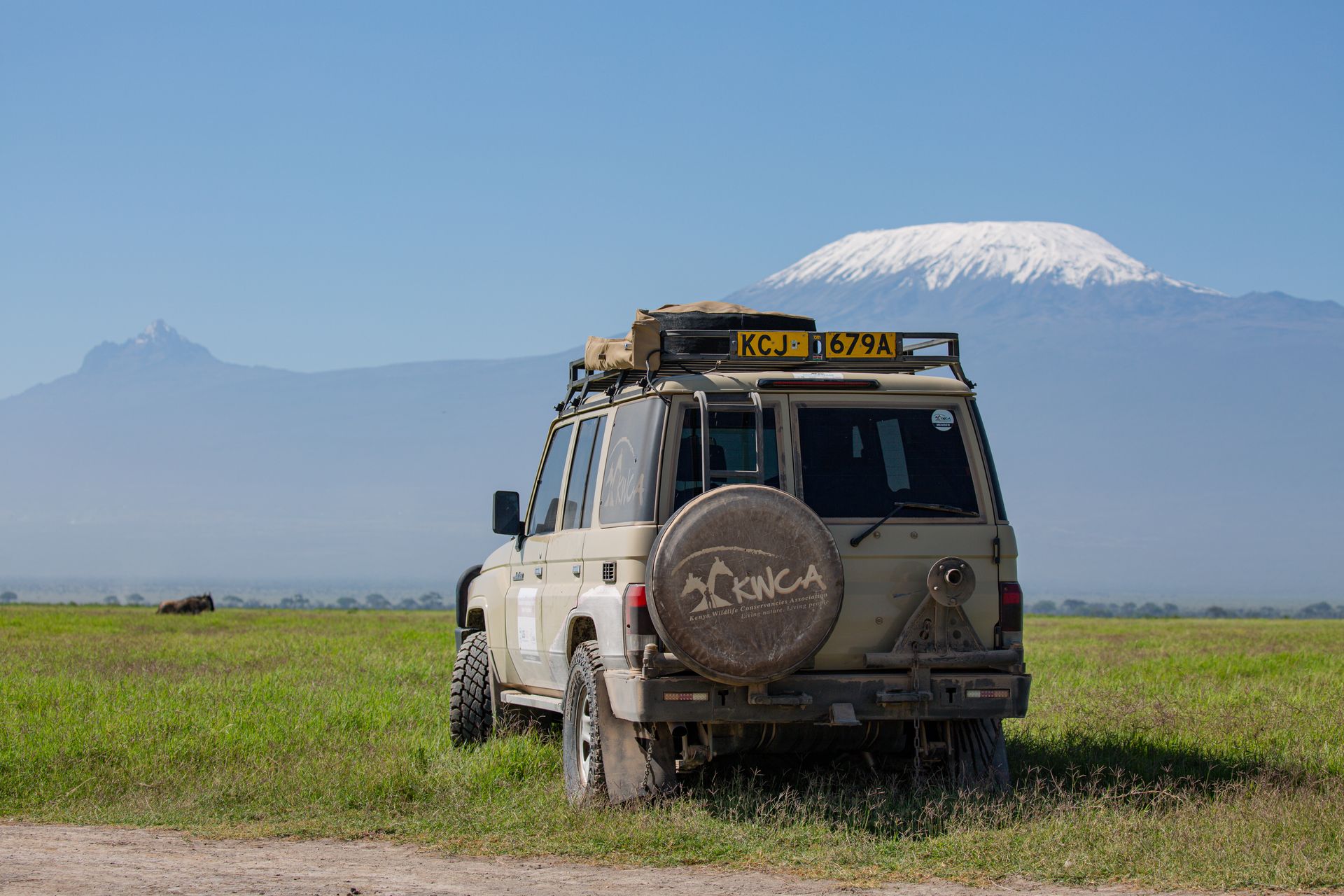

Most first-time safari travellers want the same thing: the classic Big Five safari bucket list experience, a landscape unlike anything at home and a guide who can explain what they are seeing. These are entirely reasonable ambitions and the classic destinations of the Masai Mara, the Serengeti and Kruger, deliver them reliably. That is why they are classics.
What changes on a second safari is the question you are asking. The returning traveller is no longer wondering will I enjoy safari? They are asking what do I want to understand, what are the moments that will stay with me? The shift is from spectacle to depth, from a lion sighting to understanding how a pride actually functions. From spotting a leopard in a tree to staying with it for an hour and watching it watch the bush below.
This shift changes how you should plan. A trip designed for the returning traveller can be different from a first-safari itinerary in almost every dimension if you so choose: the destination, the style of camp, the activities, the season. Getting it right is the difference between a second safari that merely confirms what you already felt and one that opens an entirely new chapter.
Not every returning traveller needs to go somewhere new. Some of the most profound safari experiences happen on a third or fourth visit to the same ecosystem, because familiarity is its own kind of depth.
The wildebeest migration is the obvious example. The Masai Mara can be visited across multiple seasons and the experience can vary enormously. The migration does not perform on demand. When it does come together, thousands of animals pouring across the Mara River in a single afternoon while crocodiles wait below, there is simply nothing like it in the natural world. We have planned trips to the Mara or Serengeti across every season and seen guests experience the crossing in full force only once in several visits. Returning specifically for that moment, with the right camp positioning and a guide who reads the signs, is a completely legitimate reason to go back.
A different season changes a familiar landscape entirely. The Serengeti in the green season is a different country from the Serengeti in July: lush, birdlife-rich, 50-90% less expensive and without another vehicle in sight for long stretches. South Luangwa in the October heat, dry riverbeds, game concentrated around dwindling water, is one of the most dramatic environments in Africa. A different camp within a known ecosystem often means a fundamentally different experience. Moving from a larger lodge to a six-tent camp on a private concession changes your relationship with the landscape even when the wildlife is the same.
The single most useful question for a returning traveller is not where should I go? but what kind of experience do I want next? The destination follows from the answer. The four directions below cover the vast majority of returning travellers with honest notes on what each actually delivers.
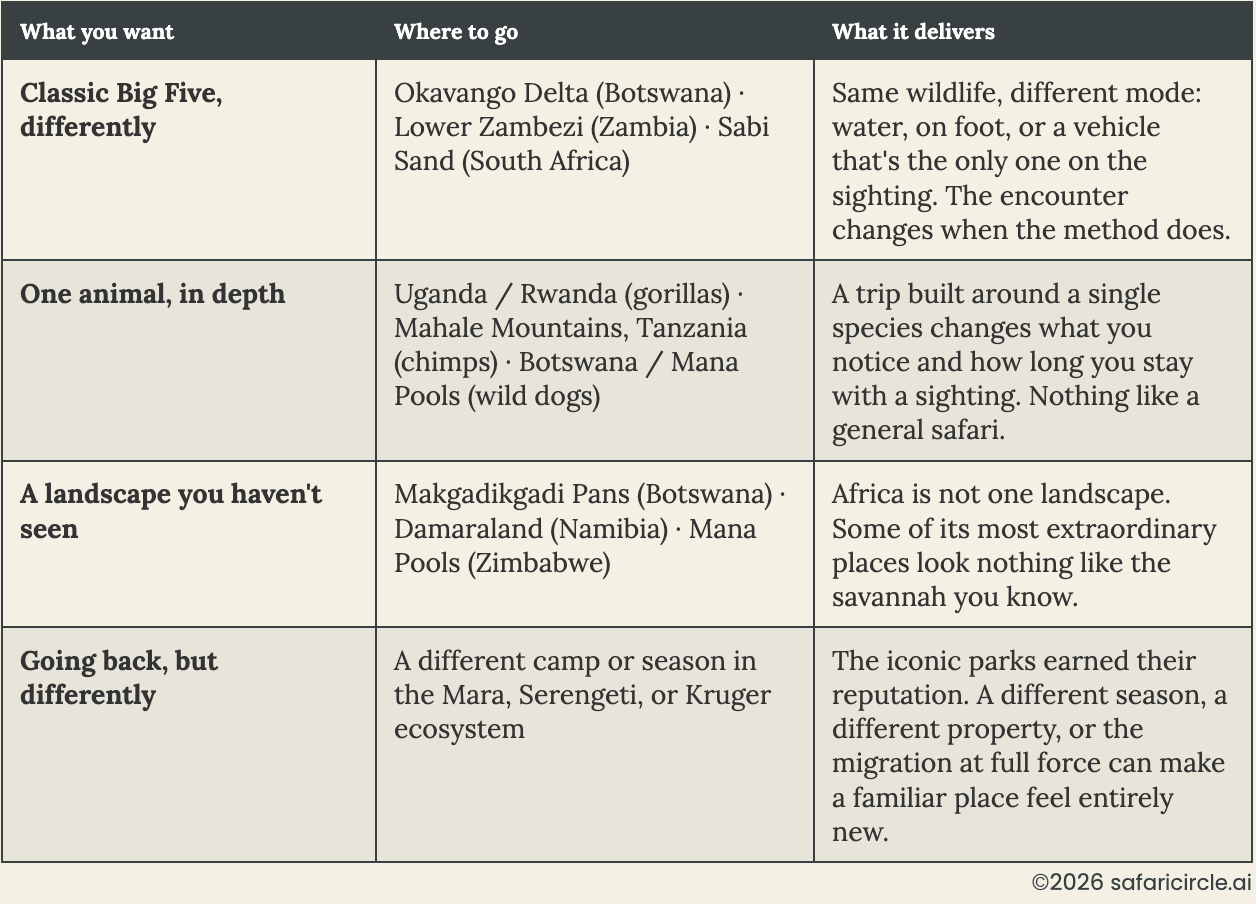
The most transformative safaris we plan for returning travellers are often built around a single species. Not as a checklist item but as the entire frame of reference for the trip. When you stop trying to see everything and instead commit to understanding one animal deeply, something shifts in how you travel.
Gorilla trekking is not a safari in any conventional sense. There are no vehicles. You walk into montane forest, sometimes for thirty minutes, sometimes for four hours, until your guide finds the habituated family. Then you have one hour with them. That hour is consistently described by travellers as one of the most memorable wildlife experiences of their lives.
Rwanda (Volcanoes National Park) and Uganda (Bwindi Impenetrable Forest) offer different versions of the same encounter. Rwanda is often seen as more polished with easier logistics, world-class lodges and shorter average trek times. The permit costs $1,500 per person. Uganda is rawer: longer drives from the gateway city or charter flights, denser forest, more demanding terrain. The reward is more habituated gorilla groups (Bwindi alone has 17), a wilder atmosphere, and a permit at $800 per person ($600 in low season: April, May and November). Both figures are correct at time of publishing (2026) and reviewed periodically.
Greystoke Mahale is one of the most singular camps in Africa: six bandas built from old dhow timber at the base of the Mahale Mountains on the shore of Lake Tanganyika, reachable only by light aircraft and then by boat. There are no roads and no vehicles. The chimpanzee trek goes on foot into the forest each morning. In the afternoon you swim in the lake, kayak, or do very little. It is entirely unlike any other safari experience and for a returning traveller who has already done the game-drive circuit, that contrast is precisely the point. Uganda's Kibale Forest is the more accessible alternative, with over 1,500 chimpanzees and a 95% sighting success rate and combines naturally with gorilla trekking in Bwindi.
The African wild dog, or painted wolf, is one of the continent's most endangered large predators and one of its most compelling to watch. A pack hunt is completely different from big cat predation: coordinated, vocal, relentless and extraordinarily fast. Botswana holds around 30% of the world's remaining wild dog population, with the Linyanti and Okavango areas among the most reliable for sightings. Mana Pools in Zimbabwe -where the BBC Dynasties series filmed its wild dog episode -offers a different experience. Walking among wild dogs alongside the Zambezi in a park where on-foot encounters are the norm, is extraordinary.
If you want to understand how rare a truly difficult sighting feels, the pangolin is the benchmark. Tswalu Kalahari in the Northern Cape is the single most reliable place in Africa to find one - and even here, nothing is guaranteed. The reserve's dedicated research programme means guides use telemetry to locate tagged individuals, which improves the odds substantially. An evening tracking a pangolin as it uncurls and begins foraging is the kind of experience that takes planning and a degree of luck - and stays with you for decades.
The majority of first-time visitors to the Mara or the Serengeti stay in or adjacent to the national reserve. That is entirely reasonable, the wildlife is extraordinary and the infrastructure well established. But it comes with a trade-off that is easy to miss until you have seen the alternative.
Inside a national reserve, vehicles must stay on defined tracks. Night drives are not permitted. Walking safaris are not permitted. When a leopard is spotted, you may share the sighting with several other vehicles. Private conservancies (land leased by lodges around the perimeter of national parks, or standalone private reserves) operate under different rules entirely. Off-road driving, night drives, walking safaris and bush meals away from camp are all possibilities. Your vehicle is often the only one on a sighting simply because no other guests are there.
The Mara North and Olare Orok conservancies in Kenya sit adjacent to the national reserve and draw from the same wildlife population, including the full benefit of the migration. The Sabi Sand in South Africa shares unfenced land with Kruger - leopard densities here are among the highest in Africa, with guides who know individual animals by name. If your first safari was in the national parks and you have not yet experienced a private concession, the upgrade is significant and worth designing an entire trip around.
Returning travellers gravitate towards walking safaris and the reason is usually the same. After one or more trips in a vehicle, the instinct is to get closer. Not physically closer to the wildlife (a walking safari is not about proximity) but closer to the logic of the bush. On foot with a skilled guide and an armed ranger, you read the landscape differently. A line of tracks in soft mud becomes a story from two hours ago. The direction a herd of impala is facing tells you something is moving upwind. You learn to be quiet in a way that a vehicle never asks of you.
Zambia is the spiritual home of the walking safari - South Luangwa in particular, where the tradition was established by Norman Carr in the 1950s. The guiding standard here is widely considered among the highest in Africa. Zimbabwe's Mana Pools is a different version entirely. Walking among elephants on the Zambezi floodplain, where animals are accustomed to humans on foot, encounters happen at close range and without alarm.
One honest note: a walking safari is not for everyone and there is no shame in that. It requires a reasonable level of fitness, tolerance for heat and comfort with genuine uncertainty. You will not see the same number of different species as on a full-day game drive. What you gain - depth, attention, the silence that only exists on foot in the African bush - is not a substitute for what you give up. It is a different thing entirely. For the right traveller it is the best experience in Africa. For others, a vehicle-based trip with a single guided walk gives you the flavour without the full commitment.
The returning traveller is, almost by definition, someone who already has a clear sense of what they value on safari,, even if they struggle to articulate it. Some people leave the bush craving more time in one place, deeper into a single ecosystem. Others want variety: different countries, different landscapes, different wildlife. Some are drawn to specialist experiences; others want total wilderness without another camp in sight. These are not preferences to override but the starting point for building the right trip.
The Safari DNA quiz takes about five minutes and identifies which of our twelve traveller archetypes fits you most closely and what that means for how your next safari should be shaped. If you have not taken it, it is the right place to start before any conversation about where to go.
I've done the Mara twice. Is it worth going back? Yes - if you go differently. The case for returning to the Mara rests on two things: season and camp. If both previous trips were in the peak July-October window, the green season (November to June) is worth considering. You get lush landscapes, exceptional birdlife, a fraction of the visitor numbers, and rates 50-90% below peak. If you have only stayed in or adjacent to the national reserve, a private conservancy (Mara North, Olare Orok, or Naboisho) changes the nature of the trip substantially. Night drives, walking safaris, and sightings with no other vehicle in sight become standard. The Mara earned its reputation. It holds up across multiple visits if the itinerary is designed accordingly.
We loved the Sabi Sand. What else compares? South Luangwa in Zambia is the answer most returning Sabi Sand guests do not expect. It is not the same as the landscape is riverine, the atmosphere less manicured, but the wildlife intensity and guiding quality are comparable. Leopard density in particular rivals the Sabi Sand. Night drives are permitted and some of the finest walking safari guiding in Africa is available here. For something more remote and wilderness-focused, the Okavango Delta in Botswana offers a water-based alternative with extraordinary predator sightings in the Linyanti and Kwando areas. Neither is a straight substitute for the Sabi Sand but both are worth experiencing on their own terms.
Is a walking safari less luxurious? Not necessarily -- though the nature of the luxury is different. The leading walking safari camps in Zambia and Zimbabwe are smaller, more remote, and more focused on the guiding experience than on the infrastructure surrounding it. The food, the service, and the attention to detail are typically exceptional. What you are giving up, relative to a Sabi Sand lodge, is the larger property comforts of a pool, spa and air conditioning in some cases. What you gain is an intensity and intimacy of experience that a vehicle-based camp cannot replicate. Some returning travellers find this trade-off immediately compelling; others prefer to do a single guided walk as part of a broader vehicle-based trip before committing to a full walking safari itinerary. Either approach is entirely valid.
Can you combine a gorilla or chimp trek with a classic Big Five safari? Yes, and it is one of the strongest itinerary structures for a returning traveller. Uganda combines naturally with Kenya: fly from Nairobi to Entebbe, trek gorillas in Bwindi or chimps in Kibale, and return to the Mara or Laikipia for a final few nights. Alternatively design a circuit around Uganda combining big 5, chimpanzees and gorilla trekking. Rwanda pairs well with Tanzania - Volcanoes National Park is close to Kigali, which has good connections to Kilimanjaro and the northern Tanzania circuit. Greystoke Mahale in Tanzania works best as a standalone extension to a Serengeti or Ruaha itinerary, given its remoteness. The logistics require careful planning around internal flight routing -your specialist can help map the sequencing.
Is a safari by canoe or mokoro more dangerous? Managed differently from a game drive, but not inherently more dangerous. A mokoro (dugout canoe) safari in the Okavango Delta is poled by an experienced guide through shallow channels. You are low on the water and among wildlife, but the speed and silence of the craft means encounters are typically calm. Canoe safaris on the Lower Zambezi or Mana Pools involve paddling alongside hippos, crocodiles, and elephants. The guide sets the lines and manages the distance. The risk is real if poorly managed; it is negligible with an experienced operator and guide. Both activities are offered as standard at reputable camps in these areas. If you are not comfortable in a small craft with no quick exit from the water, say so when planning. A good specialist will design an itinerary that suits your actual appetite for immersion.

As an independent partner of 360 Private Travel, eligible flight-inclusive holidays booked through us are financially protected by 360 Private Travel Ltd under the UK ATOL scheme, ATOL number 7514. 360 Private Travel Ltd is also IATA accredited under IATA number 91200056.
Qualifying flight-inclusive holidays are financially protected under the UK ATOL scheme, where applicable. You will receive an ATOL Certificate confirming the protection covering your individual booking.



.png)