.jpg)
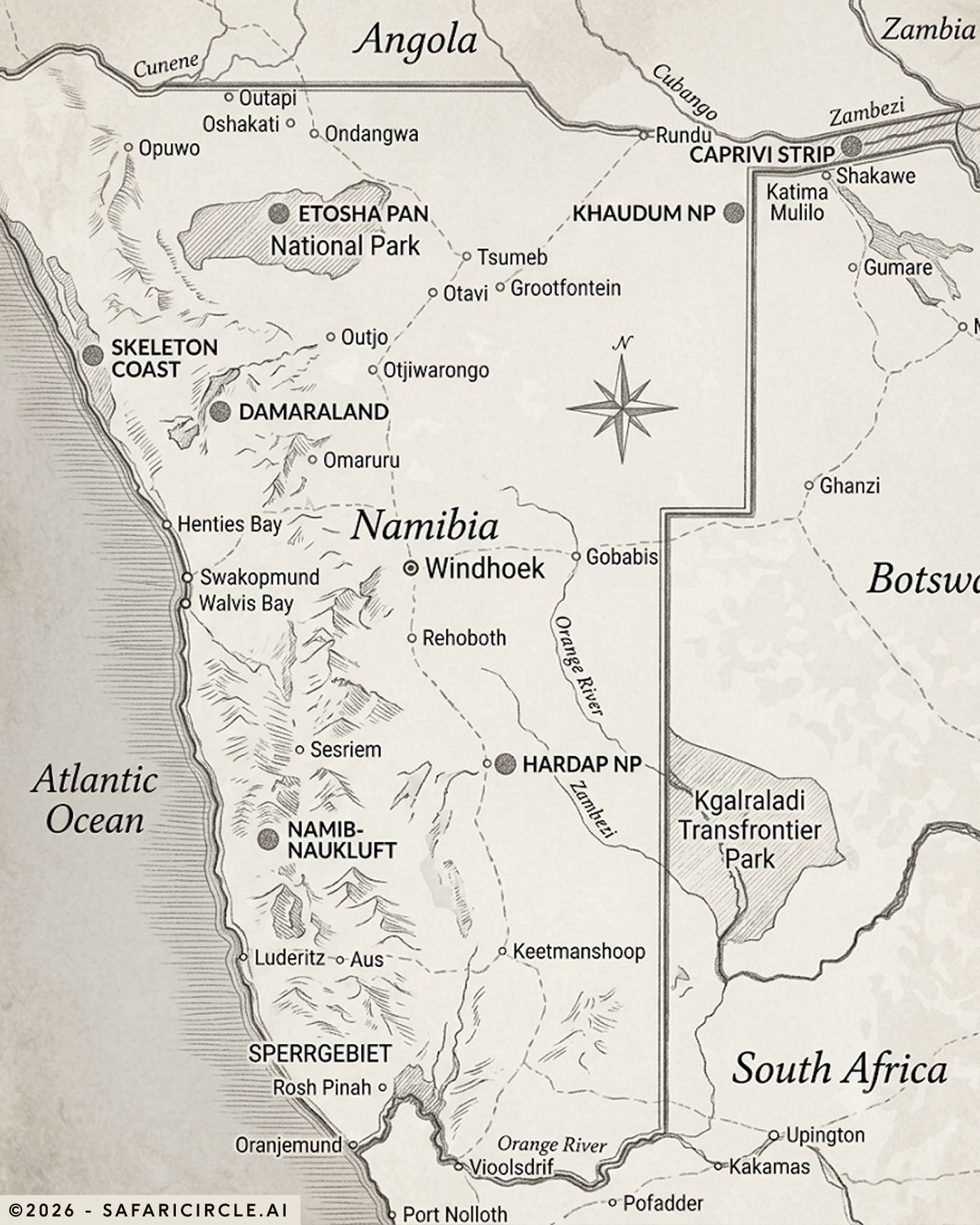
The Kunene and Kaokoveld form one of Namibia’s most remote safari regions, where desert mountains, dry riverbeds and the Kunene River meet Himba cultural landscapes. This is not a classic big-five safari; it is about desert-adapted wildlife, isolation, space and a profound sense of distance.
Kunene River
The Kunene River brings life to Namibia’s far north, creating a green ribbon against desert and mountain. Camps here offer river scenery, crocodiles, birds, boating in places and access to one of the country’s most remote cultural frontiers.
Kaokoveld Desert
The Kaokoveld is harsh, beautiful and thinly populated, with gravel plains, rocky valleys and desert-adapted wildlife moving across enormous distances. The safari rhythm is slow, scenic and deeply atmospheric.
Dry River Systems
Ephemeral riverbeds are the key wildlife corridors, drawing elephant, giraffe, oryx and other desert-adapted species when conditions allow. Tracking these routes is often more rewarding than expecting constant sightings.
Wildlife in the Kunene and Kaokoveld is desert-adapted and widely dispersed. Elephant, giraffe, oryx, springbok, brown hyena possibilities, crocodiles along the river and excellent arid-country birdlife shape the experience. Sightings feel earned, often framed by huge landscapes rather than dense herds.
May to October is the dry season and the strongest window for Etosha game viewing. Waterholes concentrate wildlife, vegetation is sparse, and temperatures are comfortable during the day but cold on early-morning drives. This is peak season - the top camps book 6–12 months ahead.
April and November are the shoulder months worth knowing about. Etosha’s game viewing is already strong, lodge rates drop, and the light is clean for photography. Sossusvlei and the Skeleton Coast work year-round as the desert doesn’t follow a wet-dry cycle in the same way.
December to March is green season in the north. Etosha’s pan can flood, attracting flamingos. Daytime temperatures exceed 35°C. Some roads become difficult. Rates drop 20–40% at many properties.
For UK families: July–August school holidays align with peak dry season. October half-term catches excellent late-dry conditions. Easter falls in the shoulder–green transition — Sossusvlei and the Skeleton Coast are more reliable than Etosha in April.

Lodges are few, remote and highly characterful, ranging from expedition-style desert camps to exclusive river lodges. The best properties emphasise guiding, cultural sensitivity, landscape immersion and the privilege of access rather than conventional safari abundance.
The region’s leading lodges are respected by specialist Namibia operators for remoteness and setting, particularly properties along the Kunene River. Awards matter less here than operational excellence: getting guests comfortably into such a far-flung landscape is the achievement.
The Kunene and Kaokoveld suit travellers who want remoteness, silence and desert atmosphere rather than easy big-game volume.
It is excellent for photographers, repeat safari travellers and those drawn to Himba culture when handled respectfully.
It is less suitable for short first safaris, young families or anyone who needs daily predator action and simple transfers.
From the UK, most travellers fly into Windhoek, usually via Johannesburg, Addis Ababa, Doha or another regional hub.
The Kunene and Kaokoveld are usually reached by light aircraft or as part of a long private guided Namibia circuit. Road journeys are spectacular but demanding.
This region is best planned as part of a longer Namibia itinerary with Damaraland, Etosha, Skeleton Coast or the Namib Desert.
Yes, but it is a desert wilderness safari rather than a high-density wildlife safari. The appeal lies in remote landscapes, desert-adapted wildlife, Himba cultural context and the feeling of being far beyond Namibia’s easier routes.
Desert-adapted elephant, giraffe, oryx, springbok, ostrich, brown hyena possibilities and excellent arid-country birds are part of the experience. Along the Kunene River, crocodiles and water-associated birdlife add a very different layer.
Three nights is usually a sensible minimum once you account for the effort of getting there. It works best within a longer Namibia journey rather than as a quick two-night diversion.
Most luxury itineraries use light aircraft from Windhoek or another Namibian safari point. Overland access is possible on longer private guided trips, but distances are substantial and road conditions require proper planning.
Only if the traveller is drawn to desert, remoteness and atmosphere more than classic big-game certainty. For most first-timers, the Kunene and Kaokoveld are strongest when paired with Etosha or another higher-density wildlife area.
The dry season generally makes travel and wildlife tracking easier, though the region has strong year-round landscape appeal. Summer can be hotter and more demanding, so comfort expectations and routing need careful handling.

As an independent partner of 360 Private Travel, eligible flight-inclusive holidays booked through us are financially protected by 360 Private Travel Ltd under the UK ATOL scheme, ATOL number 7514. 360 Private Travel Ltd is also IATA accredited under IATA number 91200056.
Qualifying flight-inclusive holidays are financially protected under the UK ATOL scheme, where applicable. You will receive an ATOL Certificate confirming the protection covering your individual booking.



.png)