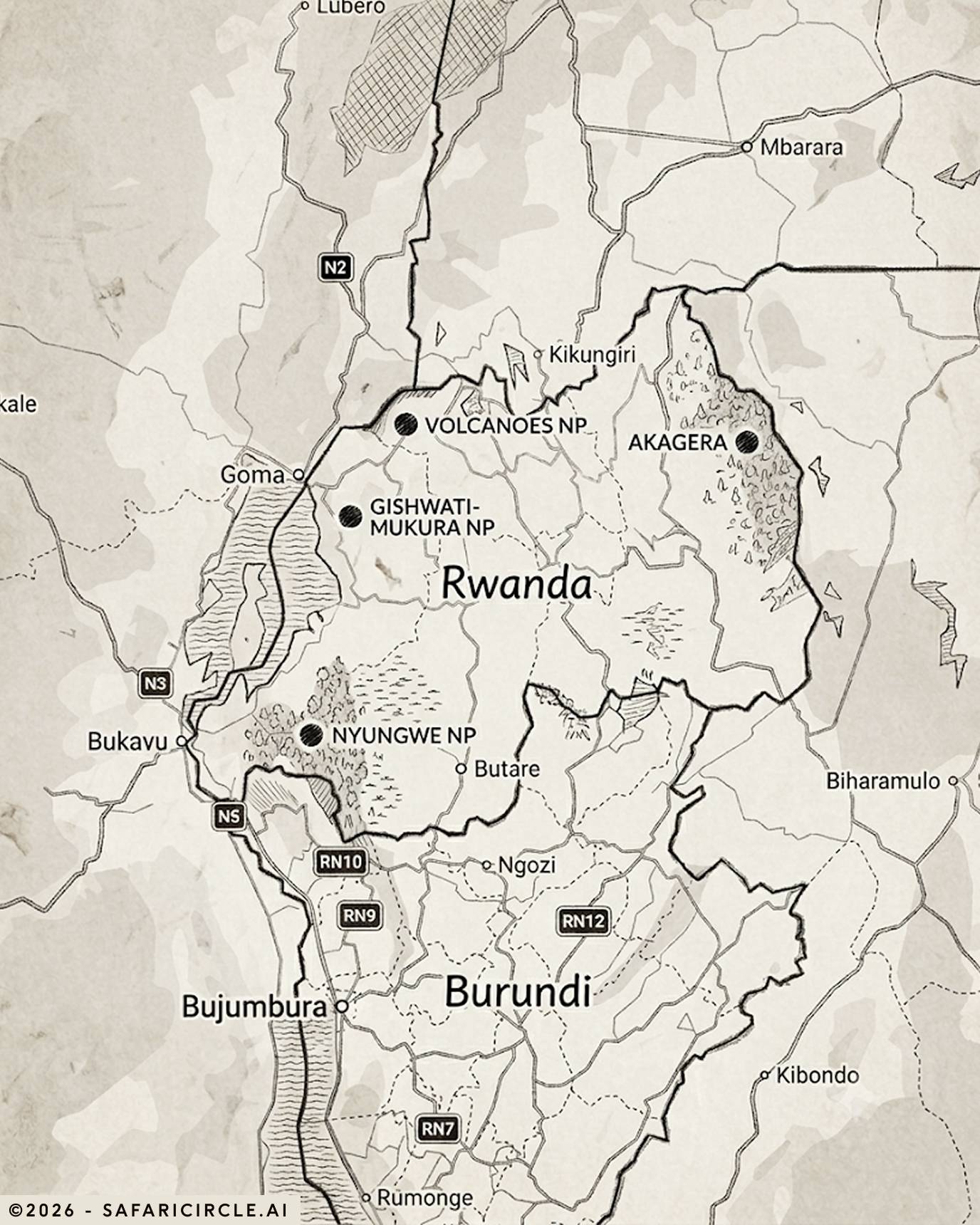
An ancient montane rainforest made for walkers and primate lovers — chimpanzees, colobus monkeys and canopy views in one of Africa’s richest forests. A safari here is best understood through its setting, rhythm and the kind of traveller it rewards. It may be a headline wildlife area, a specialist extension or a quieter pause between bigger safari chapters, but it has a clear role when chosen for the right reason.


Canopy and forest trails
Nyungwe’s trails and canopy walkway reveal one of Africa’s richest montane rainforests at a slow, immersive pace.
Chimpanzee tracking areas
Chimp tracking gives the forest its headline wildlife encounter, though sightings require early starts and some physical effort.
Tea country edges
The green hills around Nyungwe soften the journey and add cultural, scenic and lodge-based contrast.
Nyungwe is about chimpanzees, colobus monkeys, forest birds, butterflies and the life of an ancient rainforest rather than conventional savannah game.
Rwanda sits just south of the equator and works year-round. Two dry seasons frame the calendar.
June to September is the primary dry season and the most popular window for gorilla trekking. Trails are drier, trekking is less physically demanding, and Akagera’s game viewing is at its best. This is also the busiest and most expensive period.
January to February is the most underrated window. The short dry season delivers excellent gorilla trekking conditions, lower lodge rates, and easier permit availability than July–August.
March to May brings the long rains. Gorilla trekking still operates daily, but trails are muddy and treks are more demanding. Rates drop and permits are more available. Nyungwe’s chimpanzees are easier to find when fruit trees are in season.
For UK families: July–August school holidays align with peak dry season. October half-term is shoulder — variable but workable. Easter falls in the long rains and is less reliable for gorilla trekking comfort.

Rwanda’s best lodges are often highly designed, intimate and service-led, with pricing shaped by exclusivity, gorilla access and the country’s compact premium travel model.
The strongest Nyungwe Forest lodges are recognised for how well they interpret the landscape, not only for comfort. In practice, the most meaningful acclaim comes from excellent guiding, sensitive design, conservation credibility and the ability to make this specific place feel coherent to travellers.
Nyungwe Forest suits travellers who want wildlife encounters with emotional weight, especially when primates, forests or conservation stories are central to the trip.
It also works for couples and thoughtful first-timers who prefer fewer, deeper experiences over a checklist-style safari.
Families with older children can enjoy it when the pacing, trekking requirements and transfer times are planned carefully.
From the UK, travellers usually fly into Kigali, then continue by road to the gorilla, forest, lake or savannah regions.
Rwanda’s compact geography makes overland transfers comparatively straightforward, though gorilla permit timing and lodge choice shape the itinerary.
Most travellers should allow at least three nights if Nyungwe Forest is the main safari focus. Two nights can work as part of a wider route, but three gives enough time for different light, weather and wildlife patterns to emerge.
The best timing depends on the main reason for going. Dry months usually improve wildlife visibility in many safari areas, while green season can bring softer light, fewer visitors, birdlife and a more atmospheric landscape.
Nyungwe Forest can work for a first safari if its strengths match the traveller. It is important to choose it for the right reasons, rather than expecting every destination to deliver the same kind of wildlife density or lodge style.
The best lodge is usually the one with the strongest location, guiding and rhythm for the experience you want. Price and polish matter, but they should not outrank access, seasonality and how the lodge uses its surrounding landscape.
Yes, but the combination needs to preserve safari time rather than simply look interesting on a map. The best pairings are those with practical transfers and a clear contrast in wildlife, landscape or activity style.
The main trade-off is expectation management. Nyungwe Forest has a clear role, but it may not deliver every safari priority at once. A good itinerary leans into what the area does best instead of forcing it to behave like somewhere else.

As an independent partner of 360 Private Travel, eligible flight-inclusive holidays booked through us are financially protected by 360 Private Travel Ltd under the UK ATOL scheme, ATOL number 7514. 360 Private Travel Ltd is also IATA accredited under IATA number 91200056.
Qualifying flight-inclusive holidays are financially protected under the UK ATOL scheme, where applicable. You will receive an ATOL Certificate confirming the protection covering your individual booking.



.png)