.jpg)
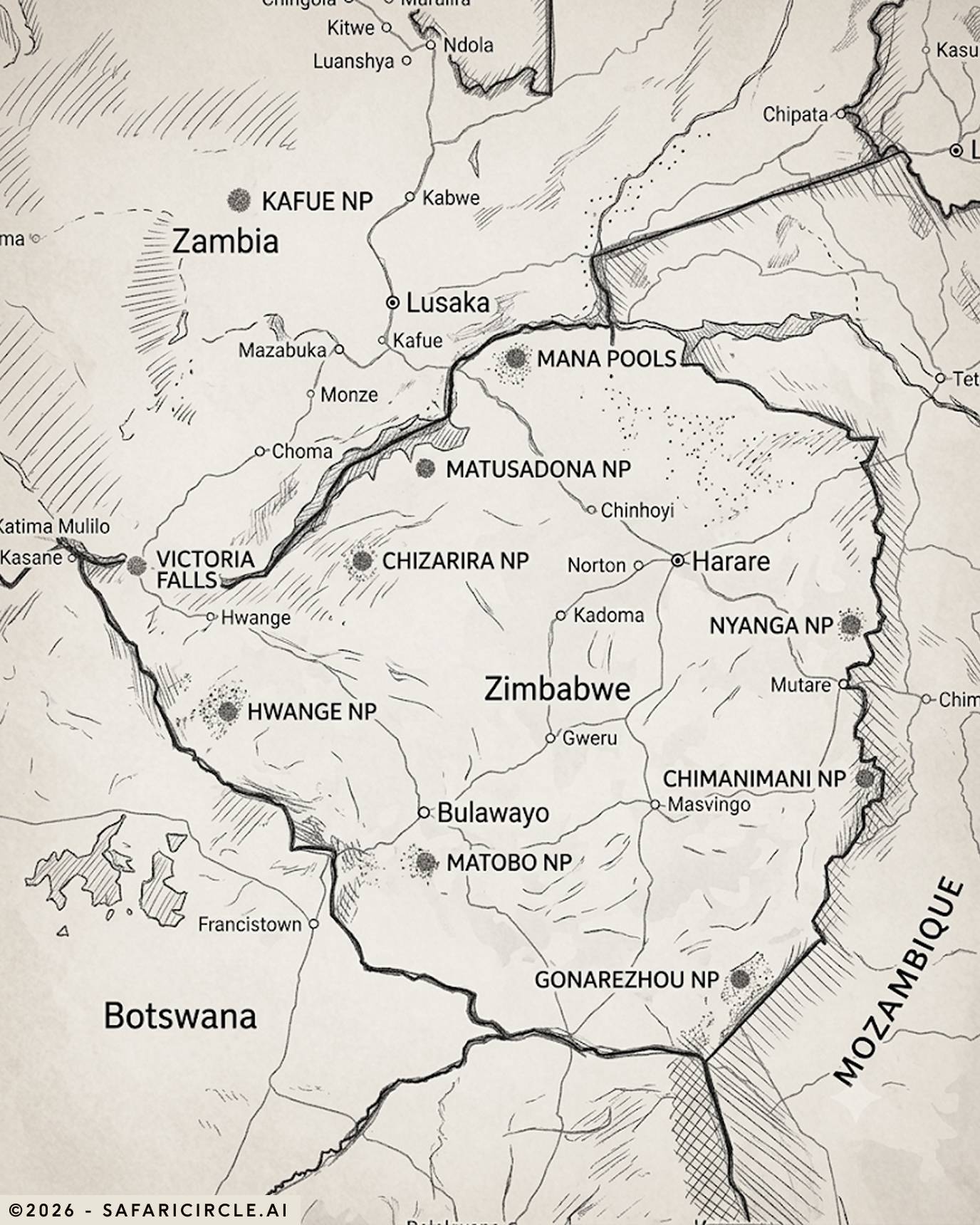
Lake Kariba and Matusadona offer a Zimbabwe safari shaped by water, escarpment and comeback wilderness. Here, game drives, boat safaris and island camps work together, with elephants on the shoreline, crocodiles in the shallows and a national park still rebuilding its big-game reputation.
Lake Kariba shoreline
The lakefront gives this region its particular rhythm: broad water, drowned trees, fishing boats and wildlife moving between islands, bays and the mainland. It is especially atmospheric at sunset, when elephants, hippo and crocodiles become part of the same wide, reflective landscape.
Matusadona National Park
Matusadona sits between the Zambezi escarpment and Lake Kariba, combining rugged backcountry with shoreline game viewing. The park has been through difficult decades, but conservation work is steadily restoring its wildlife value and giving the area renewed safari relevance.
Island and peninsula camps
Many stays here are defined by camps on islands, peninsulas or lake-edge concessions. These locations create a softer safari rhythm than classic inland reserves, with boating, fishing and shoreline game viewing adding texture between more traditional vehicle-based activities.
Wildlife in Lake Kariba and Matusadona is best understood as a water-and-wilderness experience. Expect hippo, crocodile, elephant, buffalo, antelope, rich birdlife and occasional big-cat sightings, with predator density generally less predictable than Hwange or Mana Pools. The reward is atmosphere, space and the rare feeling of safari unfolding at lake level.
May to October is the dry season and the strongest window for game viewing. Hwange’s waterhole concentrations build through the season, peaking in September and October. Mana Pools opens in April and peaks in September–October before closing in November.
September and October are extremely hot — daytime temperatures regularly exceed 40°C in the Zambezi Valley. The wildlife trade-off is worth it: animal concentrations along the river are at their densest. Early-morning and late-afternoon activities work around the heat.
Victoria Falls is at peak flow from February to May. A combined Hwange–Falls trip works in June or July, when the falls are still impressive and the parks are fully open.
For UK families: July–August school holidays align with peak dry season. October half-term catches exceptional late-season Hwange and Mana Pools. Easter falls in the transition and is reliable for Hwange and Victoria Falls but not Mana Pools.

Lodges around Lake Kariba and Matusadona tend to be intimate, lake-facing and strongly place-led. Some are polished island or peninsula lodges with pools, decks and sunset views; others are simpler tented camps focused on boating, fishing, walking and low-key safari. The best choices balance comfort with access to the revived national park.
This is not Zimbabwe’s most awards-driven safari region, but several properties here are respected by specialist safari operators for their setting and character. The real acclaim lies in the combination of lakefront beauty, remote access and conservation recovery rather than headline luxury rankings.
Matusadona’s renewed management and conservation story has also brought fresh attention to the area. For travellers interested in places on the way back, not just places already polished by reputation, that comeback narrative is a meaningful part of the appeal.
Lake Kariba and Matusadona suit travellers who want safari to feel spacious, quiet and slightly off the obvious path, rather than purely high-density and checklist-led.
It works well for couples, repeat safari travellers and photographers drawn to light, water, elephants and big horizons. The lake setting gives the experience a gentler, more restorative rhythm than many inland parks.
Families with older children can enjoy the variety of boating, fishing and game viewing, but younger families need careful lodge selection because transfers, water activities and wild settings vary by property.
From the UK, travellers usually fly to Harare, Victoria Falls or Johannesburg, then connect onward by light aircraft or regional routing depending on the lodge and season.
Lake Kariba camps are often reached by charter flight, boat transfer, or a combination of road and boat logistics. The exact route depends heavily on whether the lodge sits on the mainland, an island or a private shoreline concession.
This is rarely the simplest first safari add-on, but it combines well with Hwange, Mana Pools or Victoria Falls when handled by an operator familiar with Zimbabwe’s flight and lake-transfer patterns.
Three nights is usually the right minimum for a meaningful stay. It gives enough time for a boat safari, game drive rhythm and slower lake moments to settle in. Two nights can feel rushed once transfers are included.
The dry season, roughly June to October, is usually strongest for shoreline wildlife and easier game viewing. Green season can be beautiful for birdlife and atmosphere, but some access and activity patterns may be more variable.
It can work as part of a wider Zimbabwe itinerary, but it is rarely the safest standalone first safari. First-timers who want classic big-game density may prefer Hwange or Mana Pools first, then add Kariba for contrast.
The best lodges are those that use the lake properly, not just as a view. Look for strong boat access, good guiding, practical links into Matusadona and enough comfort to make the remoteness feel rewarding rather than effortful.
Yes. It combines naturally with Hwange, Mana Pools or Victoria Falls when flight and boat logistics are planned carefully. The strongest itineraries use Kariba as a water-based contrast, not as a replacement for core big-game safari time.
The main trade-off is that the setting can outshine the sightings. Choose it for atmosphere, lake activity and conservation recovery, while accepting that predator encounters may be less frequent than in Zimbabwe’s most famous safari areas.

As an independent partner of 360 Private Travel, eligible flight-inclusive holidays booked through us are financially protected by 360 Private Travel Ltd under the UK ATOL scheme, ATOL number 7514. 360 Private Travel Ltd is also IATA accredited under IATA number 91200056.
Qualifying flight-inclusive holidays are financially protected under the UK ATOL scheme, where applicable. You will receive an ATOL Certificate confirming the protection covering your individual booking.



.png)